How to Create a Balance Sheet Using Mind Maps with Ease
Professionals, businesses, and even students may find it difficult to comprehend financial statements. Balance sheets might appear complex due to numbers, terminology, and formats. However, comprehension can be made simpler, quicker, and even more pleasurable by employing mind maps to visually portray a balance sheet.
By arranging assets, liabilities, and equity in a systematic and memorable manner, mind maps assist in transforming complicated financial data into distinct visual branches. This article will discuss the definition of a balance sheet, its essential components, and the successful usage of mind maps for the balance sheet. The greatest mind map tool for creating and personalizing your balance sheet will also be presented.

- 1. What is a Balance Sheet
- 2. Contents of Balance Sheet
- 3. Best Mind Map Tool to Draw a Balance Sheet
- 4. FAQs about Balance Sheet With Mind Maps
1. What is a Balance Sheet
Balance Sheet
A balance sheet, sometimes referred to as the Statement of Financial Position, provides an important overview of a business's financial situation at a certain point in time. It provides a detailed account of a company's assets, liabilities, and equity, the remaining value that belongs to its owners. The accounting formula, Assets = Liabilities + Equity, is rigorously followed in this basic financial statement.
The Balance Sheet offers crucial insights into the company's liquidity, solvency, and overall capital structure by providing a thorough view. For creditors, investors, and management to evaluate financial condition and make well-informed strategic decisions, it is an essential instrument.
- • Assets are financial resources that the business owns as a result of previous deals or occurrences and from which it anticipates receiving future financial gains.
- • Fixed Assets: Long-term assets used to provide income over several accounting periods that are not meant for immediate sale.
- • Tangible assets are those that are essential to operations and have a useful life longer than a year. Hardware systems, office furniture, vital infrastructure, business vehicles, and substantial real estate holdings are examples of these necessities.
- • Non-physical assets with long-term worth and competitive advantages are known as intangible assets. Examples include legally protected patents and trademarks, a valuable commercial portfolio, and the workforce’s aggregate intellectual capital.
- • Current assets are those that are anticipated to be sold, consumed, or turned into cash within a year or one operational cycle, whichever comes first.
- • Assets that may be sold or collected and turned into cash are known as realizable assets. This category comprises a variety of inventory types, including raw materials, work-in-progress, finished goods, merchandise, and other supplies, as well as unpaid balances from clients, referred to as accounts receivable.
The Importance of Balance Sheet
There is no doubt that the balance sheet is the most crucial business document that gives us a clear picture of the company's activities, performance, and current situation, that is, whether it is prospering or finding it difficult to survive. The balance sheet's contents are extremely important to stakeholders, employees, investors, and regulators in addition to the company owner. This demonstrates how important it is to know how to read a balance sheet and comprehend its meaning and contents.
2. Contents of Balance Sheet
A balance sheet has three primary components: assets, liabilities, and owner's equity. Let's examine each one in further depth and ascertain what they stand for.
Asset
A balance sheet's assets list everything that a firm has. Each of these items or resources has a distinctive and/or quantifiable value. A company can use a procedure called liquidation to turn its assets into cash if it so chooses. Two subcategories of assets exist:
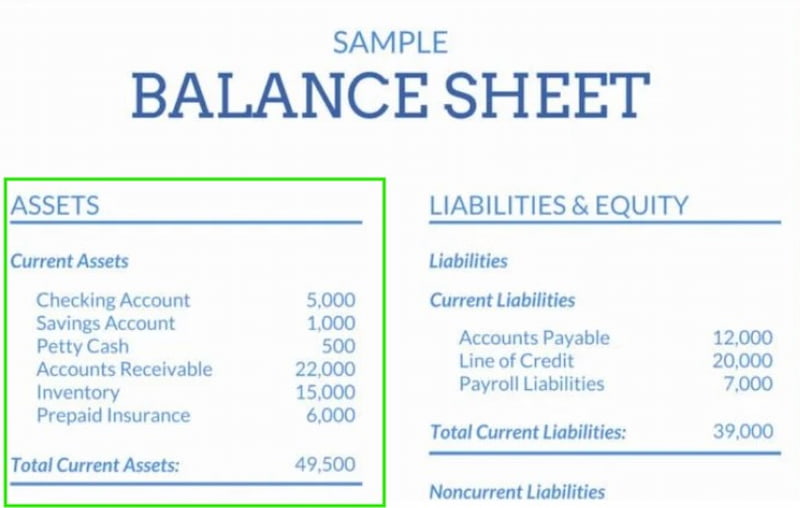
- • Current Assets. Items, goods, or objects that a business can sell within a year or less are considered current assets. Inventory, accounts receivable, marketable securities, cash or cash equivalents, and prepaid costs are all included in this.
- • Noncurrent Assets: Long-term investments that are difficult or time-consuming to liquidate are considered noncurrent assets. Trademarks, land, patents, goodwill, brands, machinery, or equipment utilized in the production of commodities or in carrying out the organization’s services and intellectual property fall under this category.
Liabilities
The exact opposite of assets is liabilities. Liabilities show what the company owes, just as assets show what it owns. Liabilities are financial and legal commitments that a corporation must fulfill to the entity it owes money. Liabilities are further divided into two subcategories.
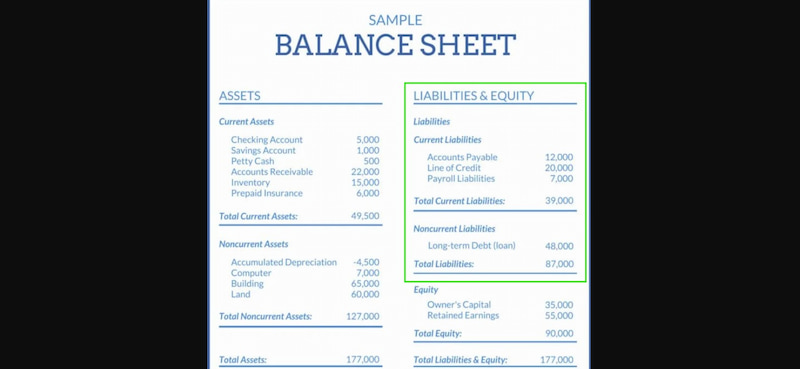
- • Current Liabilities. Liabilities that are or may be due within a year or so are referred to as current liabilities. Accounts payable, payroll costs, debt financing, rent, utility payments, and other accumulated expenses are a few examples.
- • Noncurrent Liabilities. Long-term commitments like loans, leases, deferred tax liabilities, bonds payable, and pension provisions are examples of noncurrent liabilities, which are payables that are not due within a year.
Owner’s Equity
What remains or is owned by the owner after all obligations have been settled is known as owner's equity. This is what is actually owned by the owner or shareholders without any commitments; it is also known as shareholders' equity. In a way, equity consists of two essential components.
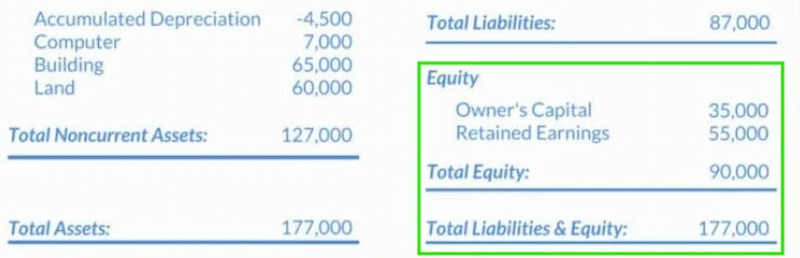
Balance Sheet Equation
Even though a balance sheet contains a lot of numbers and numerical data, the information is nearly always arranged using the following equation:
There are several ways to organize balance sheets, even though this is the standard format. Just as we may change the supplied equation, we can also change how a balance sheet's data is arranged to suit our preferences or goals.
There are two other formats:
- • Liabilities = Assets – Owner’s Equity.
- • Owner’s Equity = Assets – Liabilities
The name comes from the fact that the balance sheet's most crucial feature is that it should always be balanced. According to the default formula, the total assets of the business must always equal the sum of its liabilities and owner's equity. Similarly, the liabilities must equal the difference between the organization's assets and the owner's equity, and the owner's equity must always equal the difference between the organization's assets and the liabilities.
If neither side is balanced, there has probably been a mistake. Among the primary causes of these mistakes are:
- • When there is insufficient, inaccurate, or incomplete data.
- • When the transactions are not appropriately entered.
- • If the currency exchange rates include any mistakes.
- • Mistakes in the inventory level computation.
- • If or when the equity has been computed inaccurately.
3. Best Mind Map Tool to Draw a Balance Sheet
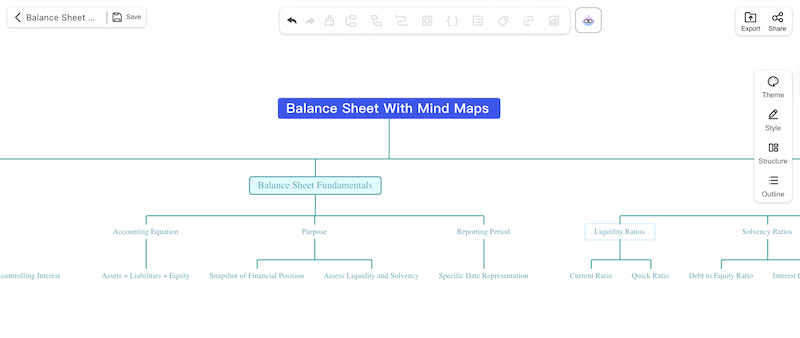
You may turn concepts into visual diagrams using MindOnMap, an easy-to-use web-based mind mapping application. MindOnMap offers a simple and innovative method of organizing data, whether you're studying, planning a project, organizing a balance sheet, or brainstorming. With only a few clicks, you can create branches, add notes, icons, links, and even attach files thanks to its user-friendly design. Teachers, accountants, business executives, students, and anyone else who loves visual learning will find it excellent. You may view your mind maps at any time and work together in real time because it is cloud-based. Additionally, it may be exported in a variety of forms, which makes it helpful for printing, reporting, and presentations.
Key Features
- • Create branches with drag-and-drop for simple editing.
- • Icons and color coding for improved visual organization.
- • Real-time sharing and cooperation through a QR code or connection.
- • Include links, notes, attachments, and comments.
- • Export as a Word, PNG, JPG, or PDF file.
Simple Steps to Use MindOnMap
Choose Create Mind Map by opening MindOnMap.
After adding your primary topic, make branches and sub-branches.
Make your visual map unique, save it, export it, or distribute it.
4. FAQs about Balance Sheet With Mind Maps
What is the main objective of financial statements?
A thorough picture of a company's financial performance and health can be seen in its financial statements. By providing information about assets, liabilities, equity, income, and expenses, they assist stakeholders in making well-informed decisions.
What distinguishes an income statement from a balance sheet?
A balance sheet displays the assets, liabilities, and equity of a business at a certain moment in time. On the other hand, an income statement displays profitability by summarizing revenues and expenses over a time period.
Why are fixed assets crucial to a business?
Fixed assets are important since they are long-term resources that are necessary for a business's operations and income creation, such as real estate or equipment. They are substantial investments that support ongoing corporate operations.
Conclusion
Financial information is easier to envision, arrange, and retain when balance sheets are created and understood using mind maps. Mind mapping divides assets, liabilities, and equity into distinct, organized branches rather than working with simple numbers and tables. Anyone, whether a professional, student, or business owner, may make better decisions, streamline financial planning, and enhance presentation using tools like MindOnMap. Visual thinking transforms intricate balance sheets into clear, insightful understandings.