GTM Strategy: Complete Definition, Elements, & How to Build
The GTM Strategy is considered a blueprint that helps businesses successfully introduce products and services to the market. It ensures that they reach the target market with the right message. So, do you want to learn more about the GTM Strategy? Then read this post. We will offer its complete definition, core elements, how to build one, and common mistakes. With that, to get more insights about the discussion, start reading everything right away.

- Part 1. Introduction to GTM Strategy
- Part 2. Core Elements of GTM Strategy
- Part 3. How to Create a GTM Strategy? (Step-by-Step)
- Part 4. Common GTM Strategy Mistakes
- Part 5. Organize the Information Using MindOnMap
- Part 6. FAQs about GTM Strategy
Part 1. Introduction to GTM Strategy
What is a GTM Strategy? Well, a Go-To-Market (GTM) strategy is a systematic plan. It outlines how a business will introduce its product or service to the market and connect with its target customers. To ensure the offering reaches the right people in the right way, it specifies the audience, value proposition, distribution channels, and price strategy.
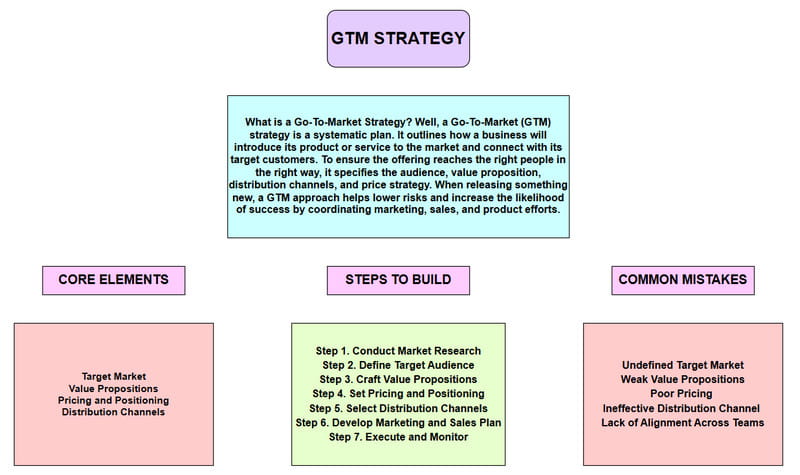
Furthermore, clear stages such as conducting market research, determining customer needs, positioning the product, and selecting the most effective channels for promotion and sales are part of creating and developing a GTM strategy. Setting quantifiable objectives and developing a plan for implementation and oversight are also necessary. This procedure ensures that all teams work toward the same goals and that the business can respond promptly to market feedback. To put it simply, a GTM strategy serves as a roadmap for transforming concepts into actual business expansion.
Part 2. Core Elements of GTM Strategy
A Go-To-Market strategy is built on various core elements. It is to ensure that a product or service reaches the right target market effectively. Plus, these elements will serve as the main foundation of the plan, guiding how a business positions itself, delivers offerings to customers, and communicates value. To get more insights about the core elements, you can check all the information below.
Target Market
The Target Market refers to the specific buyer or group of customers a business/company wants to serve. Identifying their needs, demographics, and purchasing habits helps tailor marketing and sales efforts. A well-defined target market ensures that resources are focused where they will have the best impact, helping the business achieve its assigned objectives.
Value Propositions
Another core element of the GTM strategy is Value Propositions. It explains why the target market should choose the product over others. It showcases the unique benefits, solutions, or features of your offerings. A strong proposition ensures that your products and services stand out and convince the target market of their worth.
Pricing and Positioning
Positioning establishes how your product is viewed in the marketplace, whereas pricing determines whether it appears inexpensive or high-end. Collectively, they impact competitive advantage and consumer choices. Achieving this balance ensures the target market finds your offering appealing.
Distribution and Channels
These are the methods by which your products reach customers, such as retail stores, direct sales, or online platforms. Selecting the right channel ensures accessibility and convenience. An effective distribution makes it easier for buyers to purchase and engage with your product.
Part 3. How to Create a GTM Strategy? (Step-by-Step)
Want to learn how to build a GTM strategy? Then, you can check all the steps we have provided in this section.
Conduct Market Research
You must start by analyzing the industry, customer needs, and competitors. It helps you identify opportunities and challenges before launching.
Define Target Audience
You should know your target market or customer. You must include their demographic, pain points, and behaviors. It is recommended to align your products with their needs.
Craft Value Propositions
Develop a clear statement that explains why your product is worth choosing. You must also highlight the specific problems it solves and the benefits it provides.
Set Pricing and Positioning
You can now decide how to price and position your products and services. This process balances affordability with perceived value.
Select Distribution Channels
Choose the ideal methods to deliver your products to customers. It can be via online platforms, direct sales, or retail stores.
Develop Marketing and Sales Plan
You can create campaigns and sales strategies that communicate your value propositions. You should align the sales and marketing teams around a common set of objectives.
Execute and Monitor
Launch your product and use important metrics to monitor its performance. Get input, track outcomes, and modify the plan as necessary. Constant observation helps improve the strategy and maintain long-term success.
Part 4. Common GTM Strategy Mistakes
A go-to marketing strategy can fail if the business overlooks some details or makes avoidable mistakes. Read here and explore the common mistakes of a GTM Strategy.
- • Undefined Target Market – Without a clear audience, sales efforts and marketing campaigns often miss the mark.
- • Weak Value Propositions – If product benefits are unclear, customers won’t see a reason to purchase.
- • Poor Pricing – Setting prices too low or too high can alienate customers or affect profitability.
- • Ineffective Distribution Channel – Choosing the wrong channels can make the products inconvenient to purchase or hard to access.
- • Lack of Alignment Across Teams – If the product, marketing, and sales teams work in chaos, strategy will become inconsistent.
Part 5. Organize the Information Using MindOnMap
Do you want to see all the information about the GTM Strategy in a well-structured manner? In that case, the best option is to use MindOnMap Flowchart Maker. With this tool, you can organize all the information and turn it into an exceptional visual representation. It can provide all the elements you need, including shapes, text, colors, lines, and more. You can also access the Style or Theme features to make an appealing chart. What's more, you can save your output to your account for preservation or to your device in your desired format.
To start organizing the information for the GTM Strategy, follow the steps below.
You can start accessing the MindOnMap Flowchart Maker on your browser. You can use the online version or tap the Download buttons below to use its desktop version.
Secure Download
Secure Download
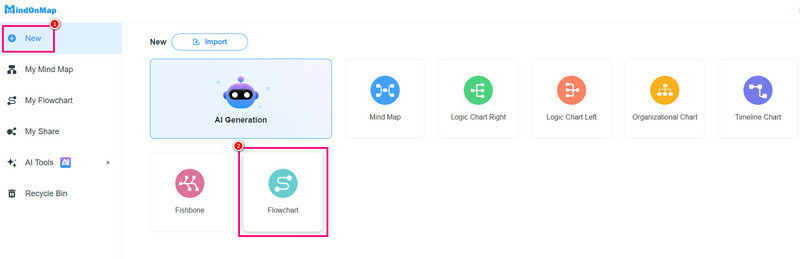
After creating your account, proceed to the New section. Then, tap the Flowchart feature.
You can start organizing the information. You can go to the General section and use any shape you want. Then, double-tap the shapes to insert the information.
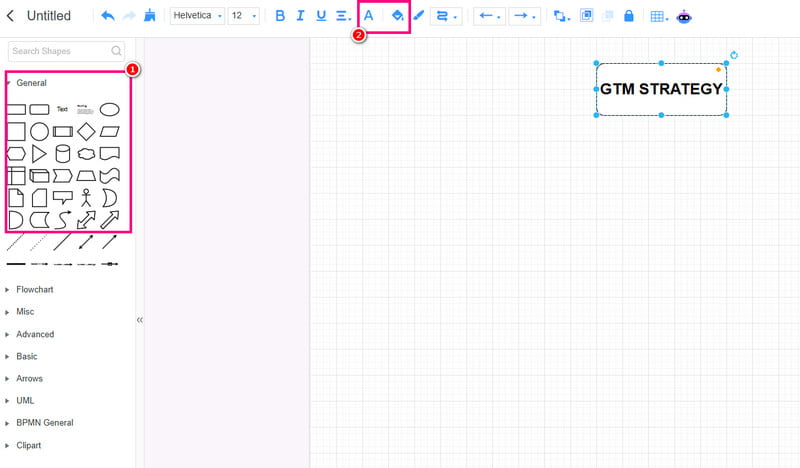
To add color to the text and shapes, you can use the Font and Fill Color features above.
Once you are done organizing all the details, you can start hitting the Save button to save the chart on your MindOnMap account. You can also use Export to save it on your device.
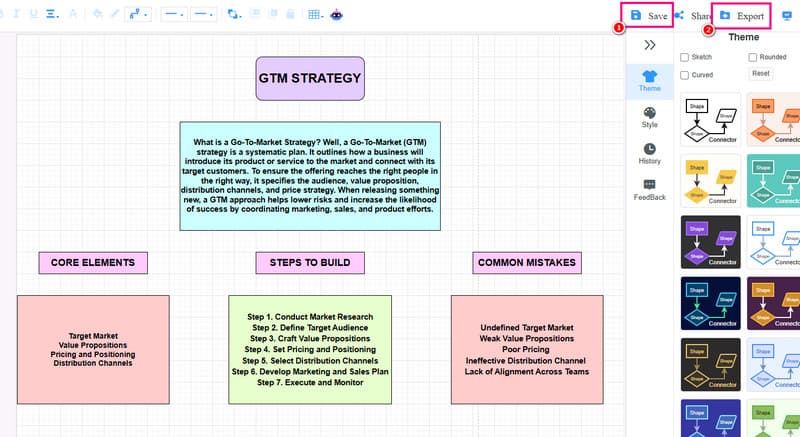
Click here to see the organized information designed by MindOnMap.
Beyond manual structuring, you can also enhance your workflow by using an AI Mind Map approach. With AI-powered tools, you can automatically transform complex GTM Strategy information into a clear and organized visual map within seconds. This not only improves efficiency but also helps identify key connections between market segments, channels, and messaging strategies more intuitively. By leveraging an AI Mind Map, you can streamline planning, improve clarity, and quickly refine your GTM Strategy for better decision-making and presentation.
Part 6. FAQs about GTM Strategy
What is GTM strategy?
A GTM (Go-To-Market) strategy is a plan for how a company launches and sells a product to its target customers.
Why is the GTM Strategy important?
It helps the business align teams, maximize the chances of success, and reduce risk. Without a clear strategy or plan, even a strong product can struggle to gain traction.
Who needs a GTM Strategy?
Any business that will launch a new product or service, enter a new market, or reposition an existing offering. The strategy is ideal for startups, established companies, and service providers alike.
Is building a GTM Strategy easy?
It depends. If you work well with your team, creating a strategy is easy because you are working with people who share your objectives.
Conclusion
Thanks to this post, you now have a clear understanding of GTM Strategy, including its core components, how to build an effective framework, and common mistakes to avoid. With these insights, you can strengthen your overall strategic planning and apply a more structured approach to market execution. To further enhance clarity and organization, you may also consider using tools like MindOnMap Flowchart Maker to visually map out key elements and support more efficient planning and decision-making.