Way to Create a Book Summary for a Better Reading Experience
A book summary is an excellent skill for educators, students, and avid readers. It allows you to distill complicated narratives into comprehensive, concise insights that can capture the essence of the text. Well, do you want to learn more about book summaries? Then, you must read this post, as we will provide its complete description, the reasons it is useful, its elements, and a guide. You will also learn how to organize all the information using an astounding tool for better visual representation. To gain more insights into the discussion, read this informative post right away.

- Part 1. What is a Book Summary
- Part 2. Why Book Summary is Useful
- Part 3. Key Elements and Guide of Book Summary
- Part 4. Organize All the Information Using MindOnMap
- Part 5. FAQs about How to Create a Book Summary
Part 1. What is a Book Summary
A book summary is a concise version of a book that highlights its major concepts, topics, and key elements. It serves to emphasize the most crucial components. It includes the primary characters, storyline, or arguments, while omitting information and long descriptions. In a condensed, easier-to-read format, the aim is to provide readers with a clear grasp of the book's subject.
In addition, a good book summary reflects the author's intent and tone, ensuring that the work's essence is preserved. It can be used for study purposes, quick reference, or to decide whether the full book is worth reading. In academic and professional contexts, summaries are particularly helpful because they enable readers to swiftly absorb complicated information and participate in conversations with a firm grasp of the text's main idea.
Part 2. Why Book Summary is Useful
The book summaries are useful for various reasons. First, they can save time by condensing lengthy text into a shorter, more manageable format. It allows avid readers to grasp the core ideas without having to read every page. Plus, it is helpful for professionals or learners who need to review multiple books instantly.
Moreover, summaries improve comprehension and retention by focusing on the core themes, plot points, and arguments. By removing unnecessary details, readers can better understand the author's content and recall crucial information later.
Furthermore, the book summary will serve as an excellent study and discussion tool. It can provide an instant reference to key concepts, engage in conversation about the book, and prepare for an exam. They make complex materials more accessible and ensure that all readers can participate meaningfully, even if they haven't read the whole work.
Part 3. Key Elements and Guide of Book Summary
There are essential components that make a good book summary work, and it strikes a balance between accuracy, conciseness, and clarity. Without overburdening the reader with extraneous details, it should convey the author's aim, highlight key themes, and summarize the key ideas. Whether the summary is intended for study, conversation, or rapid reference, it must be logically structured, presented in your own words, and appropriate for the intended audience.See below to learn the step-by-step process for making a book summary.
Read Actively
The first thing you must do is to read actively. Don't just skim through the book. You must engage with it. While reading, you have to take note, highlight, or underline necessary passages, and pay attention to recurring arguments or themes. Reading actively can help you get the author's intent. It also ensures that you won't miss important details that shape the overall meaning of the text.
Identify Key Point
After reading the book, you have to distill the content into its essential elements. For non-fiction, you must highlight the author's thesis, supporting details/arguments, and conclusion. For fiction, you must focus on the main plot, character development, and central conflict. The primary goal is to separate what is truly important from small details or filter them.
Organize Information
For the next step, you can start organizing all the information or key points in a logical order that reflects the book's structure. When arranging data, it can be chronological, especially when dealing with stories. Also, if the book is non-fiction, it must be thematic. A clear, neat outline ensures that your summary flows smoothly and makes sense to readers.
Write on Your Own Word
For the final process, you have to write your notes into a concise narrative using your own words and language. You must avoid copying sentences directly from the book. When writing a book summary, it must come from your understanding, and not just replicate the text. Additionally, keep the tone accessible and clear. You also must aim for brevity while preserving the book's essence.
Part 4. Organize All the Information Using MindOnMap
After learning everything about the book summary, you might want to organize the information for better structure and visuals. In that case, you can organize all the data using MindOnMap. With this tool, you can ensure that to create an excellent visual representation since it can give you all the necessary features. You can access various shapes, font styles, sizes, lines, arrows, and more. You can even use the Theme and Style features to create appealing visuals. What we like here is that using the tool is easy thanks to its comprehensive layout. You can also access various templates, allowing you to create your visual instantly and smoothly. Lastly, the tool can help you save your final work in various formats. You can save it as PDF, PNG, JPG, SVG, DOCX, and more. You can even keep your final output in MindOnMap for long-term preservation.If you want to start using this tool to organize all the information about book summaries, use the instructions below.
Go to the main website of MindOnMap and create your account. After that, launch its primary interface to start the main method.
Secure Download
Secure Download
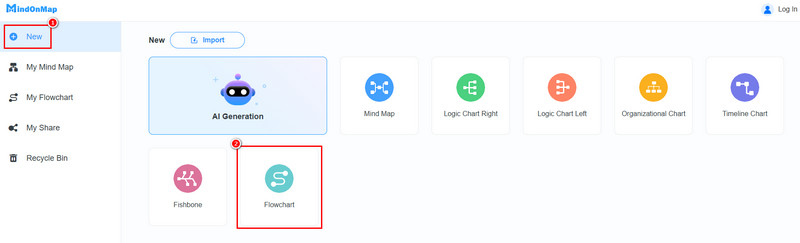
From the UI, tap the New section and click the Flowchart feature. After the loading process, the main interface will appear on your screen.
Now, start organizing all the information. You can add shapes from the General section. To add text, double-click the shape.
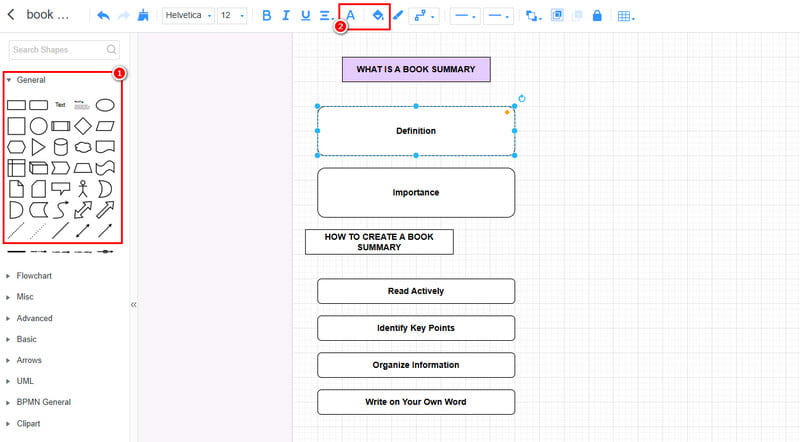
To add color to the shapes and text, use the Fill and Font features above.
For the last process, save your final work by hitting the Save button above. You can also export/keep it to save it on your device.
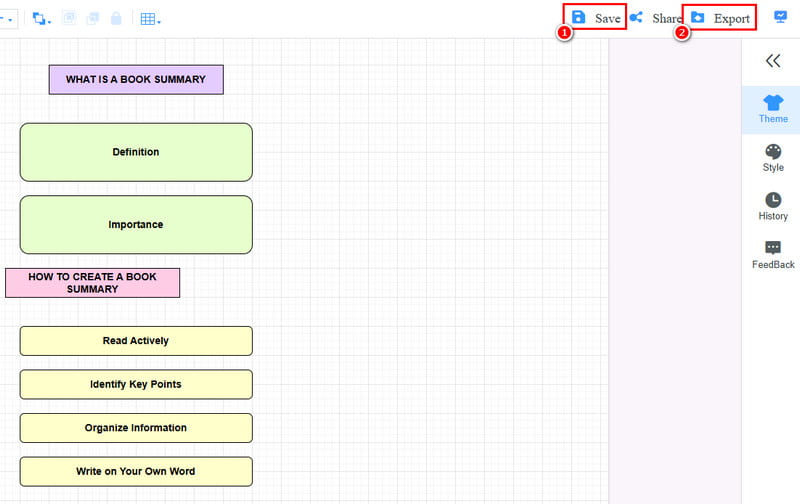
Thanks to this method, you can easily organize all the information about the book summary. The best part here is that the process is simple and fast. Thus, if you want to turn your text into a well-structured output, feel free to use MindOnMap.
Part 5. FAQs about How to Create a Book Summary
What is the best AI book summary organizer?
If you want to organize all the data about book summaries using AI, we suggest using MindOnMap. This AI-powered tool ensures you get your desired output instantly, as its AI delivers the result you need after the process.
How long should a book summary be?
The book summary must be concise. It typically ranges from a few paragraphs to one page, depending on your purpose.
Should I include my opinion on the book summary?
You should not. A book summary focuses on the author's ideas, plot, and twists without personal interpretation. If you want to include your opinion, you must place it in a separate section, such as a reflection.
Conclusion
To create a book summary, there are things you must consider. You must read the book, identify key points, organize the data, and more. If you want to learn more, then read everything in this post. Additionally, if you want to organize all the information about a book summary, you can access MindOnMap. This tool provides all the features you need to create a neat, well-structured visual representation.