What are the Different Types of Learning Styles [Detailed]
What are the learning styles? Well, learning style refers to the diverse ways individuals prefer to obtain, absorb, process, and retain information, shaping how they engage with problem-solving tasks and educational experiences. If you are interested in learning more about the learning styles, read this post. We are here to provide all the details you need about different learning styles and why they matter. After that, we will also teach you how to organize all the discussion information using an excellent tool. Without anything else, see this post and get more insights.
- Part 1. An Introduction to Learning Style
- Part 2. Why Learning Styles Matter
- Part 3. Main Types of Learning Styles
- Part 4. Organize Information about Learning Styles
- Part 5. FAQs about Learning Styles, Definitions, and Examples
Part 1. An Introduction to Learning Style
When discussing learning style, it refers to a person's natural preferred method for absorbing, processing, and remembering information. It clarifies why some people learn best with visual aids, while others learn best by moving, doing, reasoning, or listening. Plus, the idea emphasizes that every student is different and that teaching strategies should reflect this. Visual, aural, reading/writing, and kinesthetic techniques are common styles. Knowing your learning type might help you select study techniques that best suit your brain's functioning, making studying easier.
Part 2. Why Learning Styles Matter
Do you know why learning styles matter? Well, it is because they can help explain why people learn differently and how teaching can be more effective when those differences are taken into account. Additionally, when educators/professionals understand that some students grasp ideas better through visuals, while others learn prefer through listening or writing, they can design/create lessons that can reach everyone. This makes learning more engaging and inclusive, lessening frustration and enhancing comprehension.
For students, determining their own learning style is important since it allows them to select a suitable study method. For example, a visual learner might use various visual representations, while a kinesthetic learner might practice through role play and other experiments. By aligning study habits with personal learning styles, learners can boost confidence, enjoy the learning process, and retain information longer.
Part 3. Main Types of Learning Styles
Want to explore the different types of learning? Then, you can check all the details from this section.
Visual (Spatial)
One of the main learning styles you must know is the visual. Visual learners learn best when data is presented through visuals, such as images, videos, diagrams, and charts. They rely on viewing relationships and patterns to grasp concepts.
Auditory (Aural)
Another learning style is Auditory, also known as Aural. These learners obtain information via listening and speaking. They benefit from discussions, lectures, and even reading aloud. Learners can also enhance their memory by listening to music, rhythmic cues, and other sound cues.
Reading and Writing (Verbal)
Learners in this style prefer words, both spoken and written. They thrive on reading, writing essays, reading textbooks, and making various lists. They can learn better by taking notes and rewriting data.
Kinesthetic (Physical)
Among the categories of learning styles, there is Kinesthetic. Kinesthetic learners learn best through physical tasks. They prefer hands-on experiments, activities, and role-playing. For them, remembering information requires focusing on movement and touch.
Logical (Mathematical)
These learners excel at problem-solving, reasoning, and recognizing patterns. Learners enjoy dealing with numbers, structured steps, and formulas. Learning is easier for them when they break information into logical sequences.
Social (Interpersonal)
Social learners thrive in collaborative environments. Learners prefer discussing with their peers or a group. They can learn through interaction and idea sharing, helping them reinforce their understanding.
Solitary (Intrapersonal)
This learning style is the opposite of social or interpersonal. A learner prefers working alone and reflecting quietly. These learners are self-motivated and often set their own learning objectives. What suits them the best are independent study, journaling, and self-paced projects.
Part 4. Organize Information about Learning Styles
After reading about different learning styles, you have found that various styles can help learners retain information. Now, do you want to organize all the information on learning styles, including their definitions and importance? In that case, you must use a reliable tool to organize your data, such as MindOnMap.
With this AI-powered tool, you can organize all your information according to your preferences. It can even give you all the features you need to create an ideal visual representation. You can use various shapes, text, connecting lines, arrows, colors, and more. It can even offer ready-made templates for an instant visual representation-making process. Aside from that, MindOnMap offers an auto-saving feature. It automatically saves your work with every change, helping prevent data loss. You can also save your final output in your MindOnMap account, which is perfect for preservation.
What's more, this tool has a collaboration feature. With this feature, you can work together and brainstorm as you collect ideas. Thus, if you want a better tool that can organize all the information about Learning Styles, consider using MindOnMap.
To start organizing the discussion information, follow the detailed instructions below.
First, tap the Free Download button to access MindOnMap. Then, start making your account.
Secure Download
Secure Download
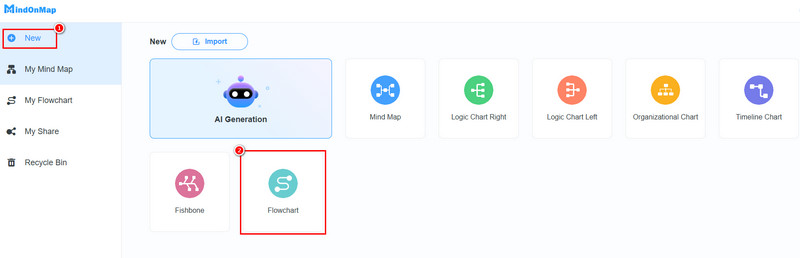
After you launch the primary layout, proceed to the New section. To view the main interface, hit the Flowchart feature.
For the next process, start organizing the information. You can go to the General section and use all the shapes you need. To insert the information, double-click the shape.
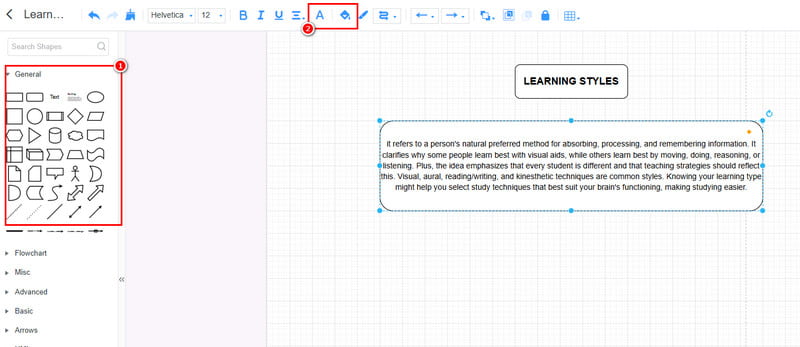
You can go to the top interface and use the Font and Fill feature to change the color of shapes and text.
Once you are satisfied with the result, you can now save your final output. Hit the Save button above to start saving your work to your account.
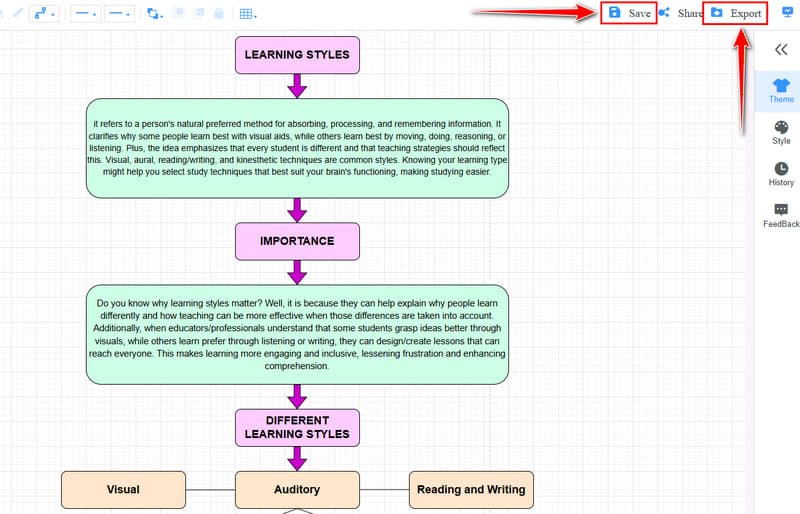
You can also use the Export feature to save it smoothly to your device in PDF, DOCX, PNG, JPG, and other formats.
Click here to see the full, organized information about learning styles created by MindOnMap.
After using this tool, we can see that organizing all the information about the learning style is easy. What we like here is that it can offer a comprehensive layout for a smooth procedure. The tool can even create various visual representations, such as RACI charts, comparison tables, family trees, and more.
Part 5. FAQs about Learning Styles, Definitions, and Examples
Can learners have more than one learning style?
Definitely, yes. Most people use mixed learning styles. For example, someone might best through visuals but also benefits from engaging with physical activities.
Can learning style change over time?
Absolutely, yes. Preferences can change depending on age, subject being studied, and experience. For example, a learner prefers visual learning in school but relies on physical or hands-on practice in a job setting.
Are learning styles the same as multiple intelligences?
They are not the same. When talking about learning styles, it is about how you learn. On the other hand, multiple intelligences describe what kinds of abilities you have.
Conclusion
Now you have learned the different types of learning styles. You even learned that various learners have their own learning styles to retain the information longer. Aside from that, if you want to organize all the information about the topic in a well-structured manner, it would be better to access MindOnMap. This tool provides all the features you need to create an exceptional visual representation that clearly shows everything about the topic.