Business Strategy: Types, Formulation, and Case Example
Business strategy is considered a blueprint that guides businesses and organizations toward achieving a certain goal. It also sustains a competitive advantage for the business. Plus, it defines how the company positions itself in the market, responds to challenges and opportunities, and allocates resources. It ensures that every action contributes to the overall success of the business. So, if you want to learn more about business strategy, check this article as we give all the details you need, including its importance, types, formulation, and more.

- Part 1. The Importance of Strategic Planning
- Part 2. Everything You Need to Know about Business Strategies
- Part 3. Strategy Overview Using MindOnMap
- Part 4. FAQs about Business Strategy
Part 1. The Importance of Strategic Planning
What Is Business Strategy?
Business strategy is a long-term plan that defines how a company will compete in the market, achieve organizational goals, and create value for customers while maintaining a competitive advantage.
Why Is Strategic Planning Important?
Strategic planning is necessary since it helps organizations to set clear objectives and decide the most appropriate way to achieve them. Plus, it gives direction to the business or company, making sure sources are utilized widely and efforts are focused. Without planning, businesses risk wasting time and funds on activities that don't support their long-term success.
In addition, planning is important because it prepares companies and businesses to deal with obstacles and adapt to possible changes. It lets leaders or stakeholders see issues/problems, explore and investigate opportunities, and sustain market competitiveness. Having a strong and strategic plan can help the business make better judgments and expand with confidence.
Part 2. Everything You Need to Know about Business Strategies
Want to learn more about business strategies? Then, you can proceed in this section as we give its types, formulation process, tools, and more.
Types of Business Strategy
Cost Leadership
Cost Leadership is among the types of business strategies where a company or business aims to become the lowest-cost producer in its industry. By maintaining the expenses at a low level, it can offer services and products at a lower price than competitors. This strategy is effective for attracting price-sensitive customers.
Differentiation Strategy
Differentiation focuses on using quality, design, or innovation to make goods and services distinctive and appealing. Customers see increased value, which enables firms to differentiate themselves in the market and raise pricing.
Focus Strategy
The Focus strategy targets a certain market segment or niche. It tailors services and products to meet its unique needs. By focusing on a smaller group, businesses can serve customers more effectively and build strong loyalty and relationships with them.
Strategy Formulation Process of Business Strategy
Analysis
The first step in the strategy formulation process is Analysis. This process is where businesses study their surroundings, environments, competitors, strengths, and weaknesses. This process helps them understand opportunities and threats in the market.
Planning
The next process is Planning. This is where businesses establish specific goals and devise plans to reach them. It includes choosing and using the optimal strategy, assigning resources, and becoming ready for potential obstacles. A strong strategy serves as a roadmap for the entire company.
Implementation
This process is where you need to take action based on the created plan. It means that you can start executing tasks, tracking progress, and adjusting when necessary. Successful implementation ensures that the business strategy can give you the desired result.
Tools and Framework for Business Strategy
In Business Strategy for Businesses, there are also tools and frameworks you need. Some of them are:
SWOT Analysis
One of the tools/frameworks you can use is SWOT Analysis. With this strategy, you can view the company's strengths, weaknesses, opportunities, and threats. With this visual representation tool, you can see what your business does well, where it struggles, and how external factors can affect success.
VRIO Framework
Another framework you can use is VRIO. With this, you can evaluate resources and capabilities based on value, rarity, imitability, and organization. This framework allows you to see whether the business's assets can give it a lasting competitive advantage compared with others.
PESTEL Analysis
When it comes to strategy, you can also use the PESTEL Analysis. This tool allows you to examine various factors, such as politics, economy, society, technology, environment, and law. This framework is useful and helpful to prepare for changes in the broader environment that can affect operations.
Poster's Five Forces
Porter's Five Forces examines competitors, suppliers, customers, substitutes, and new competitors in the market. It assists companies in understanding market forces and identifying strategies to improve their standing.
Case Example
Walmart - Cost Leadership
Walmart builds its success in its industry by focusing on cost leadership. They offer products at lower prices compared with their competitors. Through smooth chain management and bulk purchasing, it attracts those price-sensitive customers globally.
Apple - Differentiation
Apple focuses on a differentiation strategy. Its goal is to create innovative and high-quality products with different designs and strong bonding. With this strategy, they can effectively change premium prices and make customers loyal.
Starbucks - Focus Strategy
Starbucks, the most popular business in selling various coffee types, is using the Focus strategy. By targeting coffee lovers who value quality and experience, it ensures that they can get more profit from their loyal customers. They even emphasize cozy store environments, personalized service, and consistent product offerings, which is another core for strengthening its niche market.
Corporate Strategy vs Business Strategy
| Business Strategy | Corporate Strategy |
| Focuses on competing in a market | Focuses on overall company direction |
| Product/service level | Organization-wide level |
| Market positioning | Portfolio management |
Part 3. Strategy Overview Using MindOnMap
After learning everything about Business growth strategies, maybe you want to create an informative visual representation of it. If that is the case, then we suggest using MindOnMap Flowchart Creator. This tool can help you craft excellent and structured information using various shapes, lines, designs, and more. What we like about this tool is that you can even ensure to build the best and most engaging overview since it can offer its theme feature. In addition, you can save and export the Business Strategy overview to various formats, such as PNG, JPG, PDF, DOC, and more. Thus, if you want the best visual representation maker, access MindOnMap right away.
To learn how to create a structured overview for Business Strategy, use the instructions below.
Download MindOnMap on your computer and start creating your account. Once done, proceed to the next process.
Secure Download
Secure Download
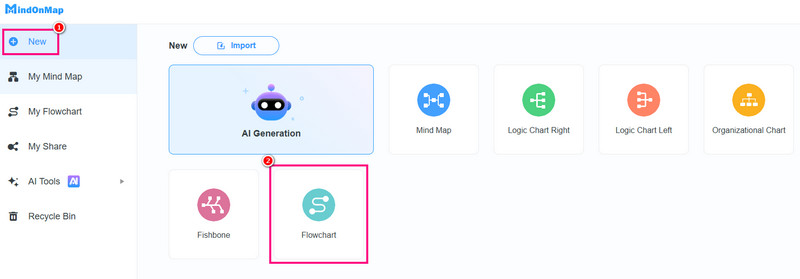
After you load the primary interface, click the New section and access the Flowchart feature.
Once the main interface pops up, proceed to the General section and use your preferred shapes. You can also insert text by double-clicking the shapes.
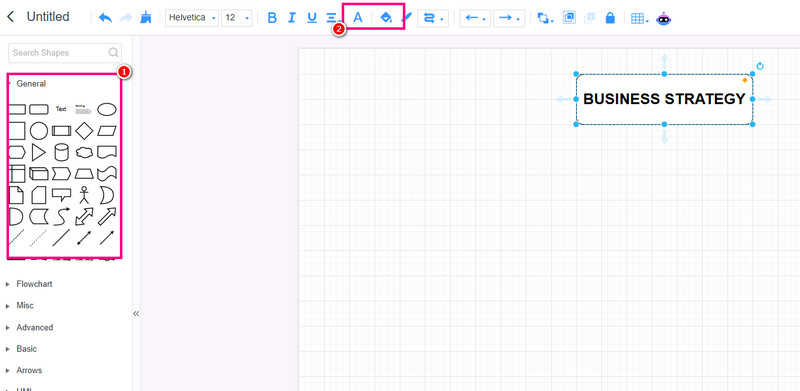
To add color, you can use the Font and Fill Color features above.
After creating the Business Strategy overview, you can start clicking the Save button to keep the visual representation on your account. You can also use the Export feature to save the overview on your desktop.
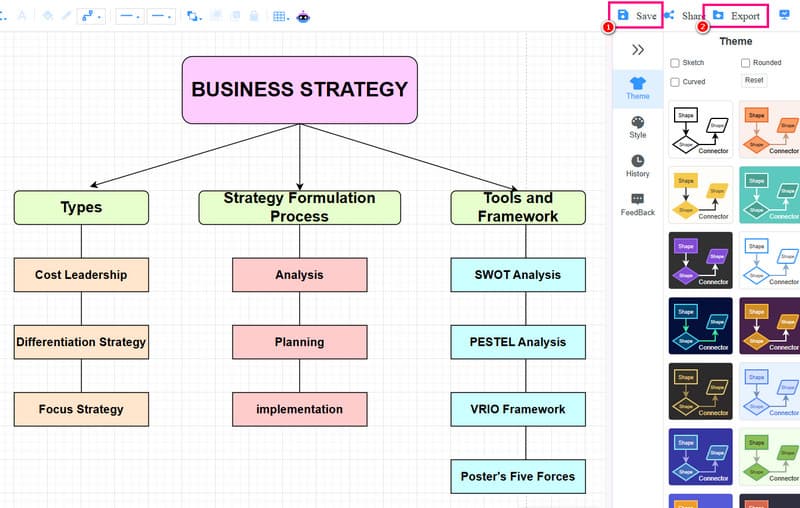
Click here to see the entire overview designed by MindOnMap.
Part 4. FAQs about Business Strategy
Why is Business Strategy necessary?
This strategy can help businesses and organizations use resources wisely, grow successfully, and respond to challenges
What are the most important parts of a business strategy?
When it comes to business strategy, the important parts are analysis, planning, and implementation. This is the best guide for a successful strategy.
Who is responsible for creating the business strategy?
In business, the ones who need to create the strategy are the leaders and top management. They must create a strategy that involves input from other departments. That way, they can insert and get all the information needed for the growth of the business.
What are the marketing strategies for a small business?
For small businesses, the most effective marketing strategies include making a strong online presence across social media platforms, leveraging local community engagement, focusing on customer relationships, and offering promotions.
Conclusion
Now you have learned everything about business strategy, along with its common types, process, tools, and more. You even learned to create a structured overview of the strategy using MindOnMap. Thus, to get all the information in a visual representation form, always rely on this tool.