Create Calisthenics Workout Chart: Guide in Healthy Living
Early in the 19th century, calisthenics gained popularity again after being invented in ancient Greece. And nowadays, people still employ these workouts to help build muscle or warm up for physically demanding activities like hiking, marathons, and more. In addition, researchers are also looking into the use of calisthenics to cure a range of illnesses, including COPD and obesity. Various degrees of rhythm and intensity are used when performing calisthenics. Sometimes these exercises are done with light handheld tools, such as rings, bars, and wands.
Indeed, this kind of workout offers so many benefits. No wonder there are many people interested in creating a Calisthenics Workout plan. Good thing, this article will help you with that. Read now.

- Part 1: 5 Kinds of Calisthenics Workouts
- Part 2: Make a Workout Plan with MindOnMap
- Part 3: FAQs About Calisthenics Workout Plan
Part 1: 5 Kinds of Calisthenics Workouts
Pullups
Equipment: Exercise Bar
Durations/Rep: 10 pullups per set.
Level: Easy
Pullups is the common kind of Calisthenics workout. This can help build strength in your back, arms, and shoulder muscles. To properly do it, follow the process below:

- • Please stand facing the exercise bar.
- • Grasp the bar from the top with your arms, add grip with slightly more than shoulder-width apart.
- • Now, use your shoulder muscles to pull yourself up, bringing your head up over the bar.
Chin-ups
Equipment: Exercise Bar
Durations/Rep: 10 chin-ups per set.
Level: Easy
Chin-ups are pretty similar to pull-ups. However, they target your bicep and chest muscles more. Therefore, if you want to make your chest and biceps bigger, then do the proper way of Chinup. Follow the tips below:

- • Similar to pullups, please stand in front of your exercise bar.
- • Grasp the bar from underneath with your arms in a tight. Then, slightly closer than shoulder-width grip.
- • It is now important to use your biceps to pull you up, bringing your head up over the bar.
Dips
Equipment: Dip Bar
Durations/Rep: 20 dips per set.
Level: Intermediate
Dips are another great way to help build your chest muscles, but this time your triceps. That means, after doing chin-ups for biceps, it is better to proceed with Dips for your triceps. Here’s how you will do it:

- • Stand inside a dip bar. Hold it with both of your hands. From there, please use your arms and shoulders to lift you off the ground.
- • After lifting off the ground, lean slightly forward to add force in your chest.
- • Bend your elbows back using your triceps to move you up and down.
Note
Notes: If you do not have a dip bar, try performing dips off an exercise ball or bench or anything that can be similar to a dip bar. You only need to keep your feet on the ground and knees bent at a 90-degree angle.
Jump Squat
Equipment: Workout Mat
Durations/Rep: 25 Jump Squats.
Level: Easy
Another calisthenic workout is the jump squat. This workout is a great help whenever we need strength-building and cardiovascular exercise. Do this work by following the instructions below:

- • Please stand with your body facing forward and your feet parallel, directly underneath your shoulders.
- • Now, move your feet a few inches apart with your toes. This must be pointed slightly outward.
- • Lower yourself into the squat, lowering your hips back and down while bending your knees.
- • Keep your chest upright, with your head and face forward.
- • Get into as deep a squat as possible, and then explode forcefully upward into a jump.
Pushups
Equipment: Workout Mat
Durations/Rep: 20 Pushups
Level: Easy
Pushups are another common Calisthenics routine, and everyone knows it. Because it is indeed a popular and effective bodyweight exercise that could help build upper-body strength and stability, it basically includes a larger portion of your body. In fact, some research also suggests that pushup strength may be associated with a lower risk of cardiovascular disease.

- • Start it by getting on your knees and placing your hands underneath. You need to slightly make your shoulders outside.
- • Then extend your legs while holding your body up with your arms. It is the moment of getting into the plank position.
- • Proceed with lowering your body by bending your elbows close to your body until your chest almost touches the floor.
- • Your upper arms should form a 45-degree angle when the top part of your body is in the lower pushup position.
- • Pause while you are in the lower position, and then push back up to the starting position quickly.
- • Keep your abdomen, or core, flexed during the entire movement.
Part 2: Make a Calisthenics Workout Plan with MindOnMap
Having a visual plan to follow for your workout routine will help you be more productive and push you to stick with the plan. That is why let us help you create a 30 Calisthenics Workout Plan, whether you are a beginner or already a pro. The process of creating a plan was made possible because of the great features of MindOnMap. In this tool, you can use a wide range of elements, such as shapes. See now its capabilities through these simple steps below:
Go to MindOnMap’s official website and click "Create Online". Please choose the Flowchart feature for creating a Calisthenics workout plan.

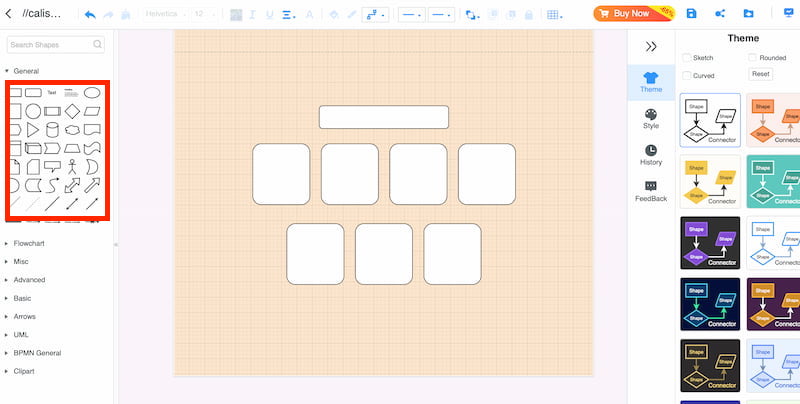
Start adding Shapes and building the design of your plan. For instance, this is a seven-day workout plan so let us design it as a calendar.
After that, insert the Text. It is important to add every workout you need for your routine.
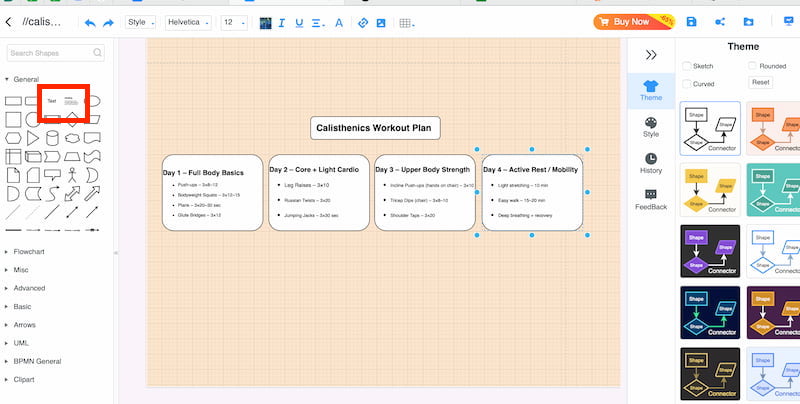
Then you can start choosing your Theme and Export your Calisthenics Workout Plan with the file format you need.
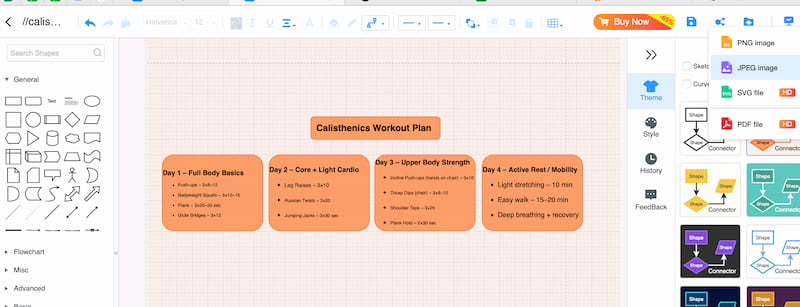
That is the great help of MindOnMap in creating your Calisthenics workout plan. You can see that it helps us organize the workout you need for a week or even a month. Use it now and be productive with your reps. In addition to that, it has some AI-integrated features, such as helping users make a family tree.
Part 3: FAQs about Calisthenics Workout Plan
Q: Is it possible for novices to begin calisthenics without any equipment?
A: Yes. Numerous calisthenics movements, including lunges, squats, and pushups, do not require any special equipment. Later on, bars or dip stations might be added for advancement.
Q: How frequently should I train out with calisthenics?
A: In order to recover and prevent overtraining, beginners can begin with three to four sessions per week, with days off in between.
Q: Is it possible to lose weight with calisthenics?
A: In agreement. Strength training and cardiovascular benefits are combined in calisthenics, which aids in calorie burning and lean muscle growth.
Q: Does it require a warm-up when starting calisthenics?
A: Yes. You can add a warm-up reminder in your Calisthenics workout plan. These warm-ups can prepare your muscles, reduce injury risk, and improve performance.
Q: How long does it take to see results from calisthenics?
A: It varies by consistency, diet, and starting fitness level. Many beginners notice improvements in strength, endurance, and body composition within 6 to 8 weeks of regular training.
Conclusion
Calisthenics is an easy yet effective method to increase your strength, stamina, and flexibility. Pushups, squats, and pullups are examples of workouts that allow anyone to advance at their own rate. Using programs like MindOnMap to create an organized plan guarantees motivation, consistency, and quantifiable outcomes. Begin now, maintain your discipline, and do calisthenics workouts to revolutionize your fitness path.