What is the Purpose of the DMAIC Framework: Get to Know It
We are now living in an era where business is more dynamic and should improve over time. These elements are great to keep the business competitive and to continuously achieve its goals. In line with that, one of the mediums to use in ensuring these elements are present is the DMAIC process. This stands for Define, Measure, Analyze, Improve, and Control. Let us now get to know it more and see how it can drive improvements to your business.

- Part 1: What Is the DMAIC Process
- Part 2: The Five Phases of DMAIC
- Part 3. Essential Six Sigma Tools for Each DMAIC Phase
- Part 4: Real-World Applications of DMAIC
- Part 5: Common Mistakes in DMAIC Implementation
- Part 6: Use MindOnMap to Visualize the DMAIC Workflow
- FAQs about DMAIC Process
Quick Answer: The DMAIC process is a data-driven improvement framework used in Six Sigma to solve problems and optimize business processes. It consists of five phases: Define, Measure, Analyze, Improve, and Control. Teams use this structured approach to identify root causes, implement effective solutions, measure results, and sustain long-term improvements.
Part 1: What Is the DMAIC Process
What is the DMAIC Process
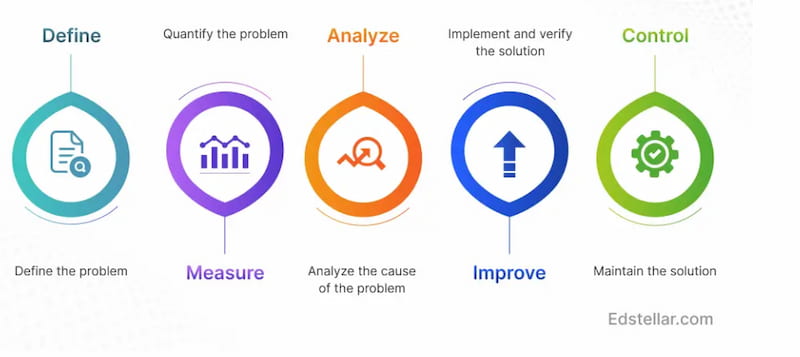
As we mentioned, DMAIC Process simply stands for Define, Measure, Analyze, Improve, and Control. To pronounce it, you just need to read it as dee-may-ik. This process has five phases. The Define. It is where you see your problem. Then the Measure. The process of gathering data as you understand more about the performance of your business. Next is, Analyze, the process of investigating dates as we identify the main cause of the problem. Also, we have improved. This is where you start implementing solutions for the issue. Lastly, Control. It is where you sustain the improvements for long-term results. All of these will be defined in depth in the next part of the article.
Teams can also use process mapping to visualize workflows, identify bottlenecks, and understand how different steps connect before starting an improvement project.
Role in Six Sigma
As we move on to the role of the process in Six Sigma, the DMAIC process plays a huge role in being the central improvement cycle. This process can ensure that any changes are factual and have measurable evidence. Commonly, these three points explain the role of the DMAIC process in Six Sigma:
- • Data-driven decisions. It has measurable data for analysis to prevent guesswork.
- • Allows continuous improvement. The control phase presents a long-term improvement for your business.
- • Foundation of projects. The initiatives in Six Sigma commonly use DMAIC as their roadmap. This can track their process inefficiencies.
Part 2: The Five Phases of DMAIC
We already gave you a surface idea about the five phases of the DMAIC Process. Now, it is important to get to know them deeper because they will be the backbone and foundation of the process.
Define Phase
It is the foundational stage of the DMAIC Process. The objective here is to clarify the issue or problem in your business or organization. More than that, it’s where you provide wider details about the project scope for a clear execution plan.
Measure Phase
Gathering data is really important in this process. Because it will become the baseline of your process, this can give the ability to do a comprehensive plan, as all of the statements are structured with accurate sources. This basically ensures reliability in your process. For a more systematic approach, teams can explore different root cause analysis methods to identify the underlying factors contributing to a process problem.
Analyze Phase
This phase is where you start seeing and observing the root cause of the problem. More than that, it is where we start uncovering the underlying factors that affect and allow the issue to exist.
Improve Phase
Then we have the improvement phase, where we start to create and implement valid solutions to solve the problem. This is where you start incorporating your techniques and strategy that can deliver positive results.
Control
Then, finally, we have the Control phase, where it is crucial to ensure the sustainability of the improvements we get. This is where you ensure that the result is for long-term success.
Part 3. Essential Six Sigma Tools for Each DMAIC Phase
The DMAIC framework becomes more effective when teams use the right Six Sigma tools at each stage. From defining the project scope to monitoring long-term results, these tools help teams make data-driven decisions and solve problems systematically.
| Tool | DMAIC Phase | Main Purpose | Best For | Recommended Team Size |
| SIPOC Diagram | Define | Maps suppliers, inputs, processes, outputs, and customers to clarify project scope. | Beginners, project managers, and cross-functional teams defining a process. | 3–8 people |
| Measurement System Analysis (MSA) | Measure | Evaluates whether a measurement system produces reliable and consistent data. | Quality engineers and analysts validating measurement accuracy. | 2–5 people |
| Fishbone Diagram | Analyze | Organizes potential causes of a problem into categories to support root cause analysis. | Teams investigating complex quality or operational issues. | 4–8 people |
| 5 Whys Analysis | Analyze | Identifies underlying causes by repeatedly asking why a problem occurs. | Small teams addressing straightforward process problems. | 2–6 people |
| Pareto Chart | Analyze | Ranks problem categories by frequency, cost, or impact to identify priorities. | Quality managers and analysts deciding which issues to address first. | 2–5 people |
| Control Chart | Control | Tracks process performance over time and helps identify unusual variation. | Quality control specialists and operations teams maintain improvements. | 2–5 people |
How to Choose the Right Six Sigma Tool
Not every DMAIC project requires every tool. Start with a SIPOC diagram to define the process, then use MSA to validate measurement reliability before analyzing data. Fishbone diagrams and 5 Whys help teams investigate potential root causes, while Pareto charts highlight the most significant problems. After implementing improvements, control charts help monitor process stability and sustain results.
For small teams, a SIPOC diagram, 5 Whys analysis, and a simple Pareto chart may be enough to begin. Larger or cross-functional teams working on complex processes may benefit from combining multiple tools and involving specialists in quality, measurement, and data analysis.
Part 4: Real-World Applications of DMAIC
DMAIC Process is a method that is helpful in real-life situations. In line with that, here are common real-world fields or applications of DMAIC:
Manufacturing
The essence of using the DMAIC framework in manufacturing is to improve the quality of the product you sell. This process can reduce the defects and implement correlative solutions as they continuously improve quality levels.
Healthcare
There are various hospitals that have implemented DMAIC to observe their patient readmission rates. In this field, professionals can easily define the problems that are always measured with key metrics, see the root causes, and continue to reduce discharge procedures.
Customer Service
Reducing the call center waiting times can be possible with the DMAIC process. Companies use it to define acceptable wait time for customers and to lessen the call abandonment rates. All of these are practiced to ensure that their services will be smoother for their customers.
Part 5: Common Mistakes in DMAIC Implementation
People have different understandings of the DMAIC process, and some have misconceptions about it. With that, here are the common mistakes they are committing when they are implementing the DMAIC process:
Poor Problem Definition
Many teams rush to define the problems that lead to creating plans that are not aligned with the real problem and result-driven actions.
Skipping Measurements and Analysis
Most of the time, they see measurements and analysis as nonsensical phases and will go directly to creating solutions. This can give you actions that are not accurate and can give you nothing in the end.
Weak Control and Follow Ups
They do not see the Control phase as something that will run long-term. Many people believe that when the results are out, the process is already finished. But it is really about sustaining it.
Part 6: Use MindOnMap to Visualize the DMAIC Workflow
We get to know and understand the process of DMAIC. We see the values that can add up to the development of your business. Now, we shall see how MindOnMap can help you create the visual presentation of your DMAIC process. This tool is everything you need to implement DMAIC. It has many features that you can use, such as shapes, text, elements, themes, and more. See how you can use it easily:
Download and install MindOnMap on your computer for free.
Secure Download
Secure Download
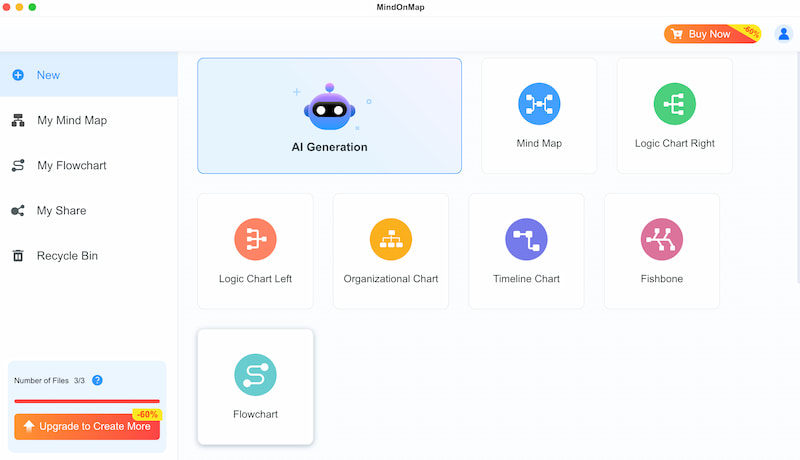
Open the tool and click on the Flowchart feature. This will give you more features in creating the DMAIC process.
Start the structure of your process by adding a shape that can represent each phase of DMAIC.
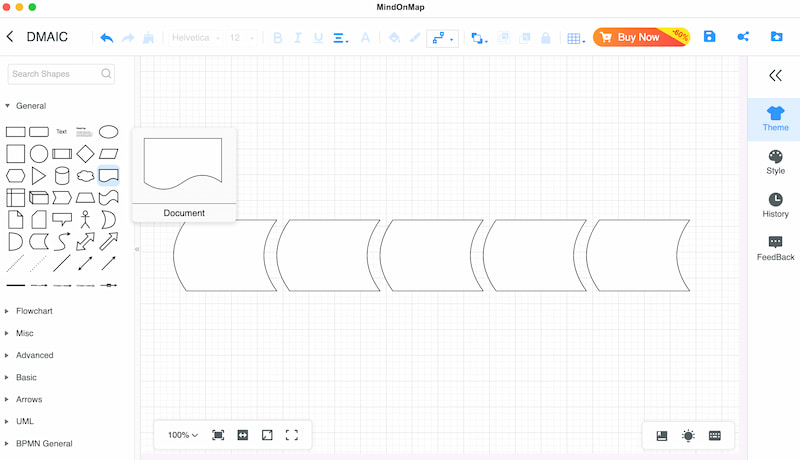
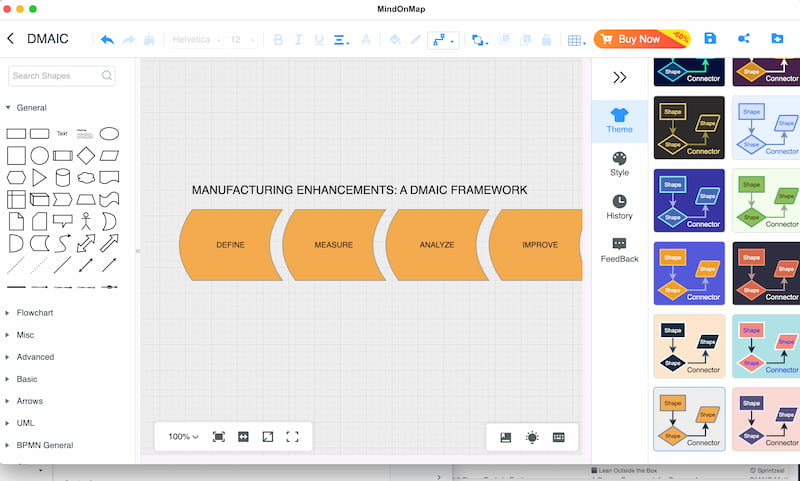
Use the Text features to add details in your process. Note that this is where you start applying what we learned above. Deeper research will be done.
Set the Theme in accordance with your preference and save it.
FAQs about DMAIC Process
Why is the Control Phase important?
The Control Phase is important because it is where you see the long-term result of the process that can give you a continuous drive for improvement. So do not overlook it.
Who uses the DMAIC process now/
The DMAIC process is commonly used by Six Sigma practitioners, such as Green Belts and Black Belts. However, any team related to continuous improvement industries can also use it.
How long does a DMAIC project take?
The time will always depend on the scope of the project and its complexity. The small projects can last up to weeks, while bigger projects can take months or a year.
Conclusion
As we get to the conclusion, we can see that the DMAIC process really brings essential things to business. It helps drive improvements and bring changes among organizations. In line with that, MindOnMap simply gives everything we need to produce the visual for all of the phases. Use it now and start bringing changes to your organization using DMAIC.