MoSCoW Prioritization Method: What it is and How it Works
Let us say you have an unending list of criteria for the project but the problem is the budget is really small and you have limited resources. With that, you are aware that it might be impossible to fulfill the deadline with the entire list of priorities provided, even with the most upbeat, driven mindset. In situations like this, you should use a prioritizing strategy like the MoSCoW method to make the process of the project manageable still. MoSCoW Prioritization Method is among the most straightforward and efficient, and it may be used in a variety of business domains.
Please continue reading if you want a surefire method to increase results, reduce project delays, and avoid project failure. Learn about the MoSCoW method and how to use it to organize, evaluate, rationalize, align, and define priorities.

- Part 1: What is the MoSCoW Method
- Part 2: Advantage and Disadvantage of of MoSCoW Prioritization Method
- Part 3: Implementing MoSCoW With MindOnMap
- FAQs about Moscow Prioritization Method
Part 1: What is the MoSCoW Method
The MoSCoW method is referred to as the MoSCoW technique or MoSCoW analysis. It is a framework for prioritizing tasks or requirements according to their value and importance. Most likely, project managers and SaaS product developers are the main users of this straightforward system. However, it may also be utilized in any company discipline, including marketing and design. As we make it simple to understand, the MoSCoW technique divides priority into four areas in order to maximize time, money, and effort management. With that, these four categories or groups are the following:
1. Must Have
Must-haves at first which are the non-negotiables. These are the absolute minimal requirements you must meet in order to start your project or endeavor. Because they possess one or more of the following four characteristics, must-have jobs can be easily identified as Minimum Viable Product or MVP, Resource concentrated, Legal risk, and Safety risk.
2. Should Have
Your should-haves are significant and very desirable. Even if they would all improve the launch, the project or effort as a whole would still be successful without them. You may identify jobs that need to be completed since they are typically, Not solution dependent, Inefficient but acceptable, Next release feature, and Low pain for users.
3. Could Have
Could-haves are all desirable extras. That means they are not essential to achieving the ultimate objective. To put it another way, these are all bells and whistles features or specifications. There are three methods to identify potential things for your list and these are the Low impact, Optional add-on, and Small perks.
4. Won’t Have
Won't-haves are the things that are not a priority and will most likely not be incorporated into the current project or endeavor. However, this does not imply that they will be abandoned permanently. Some will most likely become essential components of subsequent stand-alone initiatives. It functions almost as an ideal repository for upcoming innovations.
Part 2: Advantage and Disadvantage of MoSCoW Prioritization Method
After we learned some important points about the MoSCoW Method, let us now balance the review of it by showing you some advantages and disadvantages of the method. As we all know, no method is perfect so better to know what might be lacking in the method we are using. In line with that, here are the advantages and disadvantages of MoSCoW Prioritization Method.
PROS
- A straightforward, adaptable, and iterable framework for setting priorities.
- Encourages alignment and participation from stakeholders.
- Prioritizes meeting essential needs.
- Reduces the possibility of failure or missed delivery.
- Maximizes the value of the resources provided.
- Suitable for a wide range of disciplines.
- Minimizes scope creep.
CONS
- Success depends on the validity of the ranking standards applied to each category, which must be determined individually.
- Lacks a technique for setting priorities inside categories.
- Risk of opinion bias if the appropriate parties are left out.
Part 3: Implementing MoSCoW With MindOnMap
MoSCoW Prioritization Method definitely gives a lot of advantages and helps with our business. Many users suggest that implementing it with mind maps makes it easy to understand and not overwhelming to look at. Therefore, in this part we MindOnMap will help us create your MoSCoW Prioritization Method maps with ease. Because this tool is a popular tool that helps many users create theory mind maps without complication. Its wide features elements can help us make whatever mind maps we need. Plus an AI integration is available here for a more instant creation. Let us now look at the capabilities of this tool by showing you its key features and the simple steps on how to use it.
Key Features of MindOnMap
- • Create different kinds of mind maps including a MoSCoW chart.
- • Wide options for elements like shapes and themes.
- • Supports different file formats.
- • Available for online and software usage.
- • AI Integrated for easy creation.
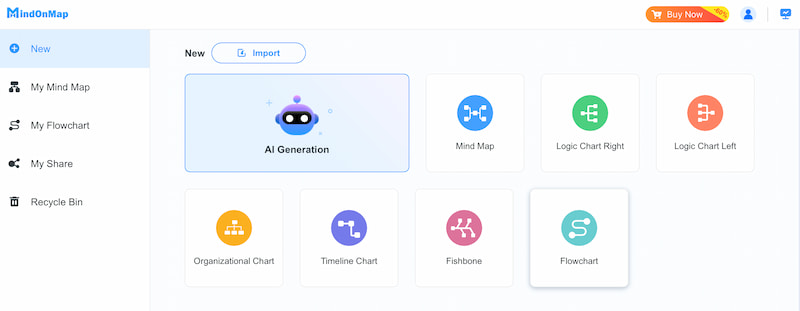
Download MindOnMap on your computer for free. Then immediately launch it as we approach its main interface. From there, please click the Flowchart feature. This will help us create your MoSCoW Chart with ease.
On the main editing interface, you can use the Shapes elements to build the foundation design of the chart. Then, use the Text features to add the details on your MoSCoW chart.
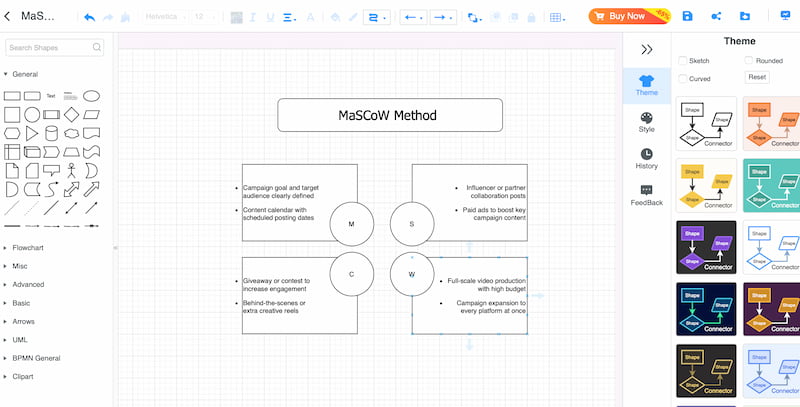
Finalize the chart by choosing your overall Theme and proceed with saving it by clicking the Export button.
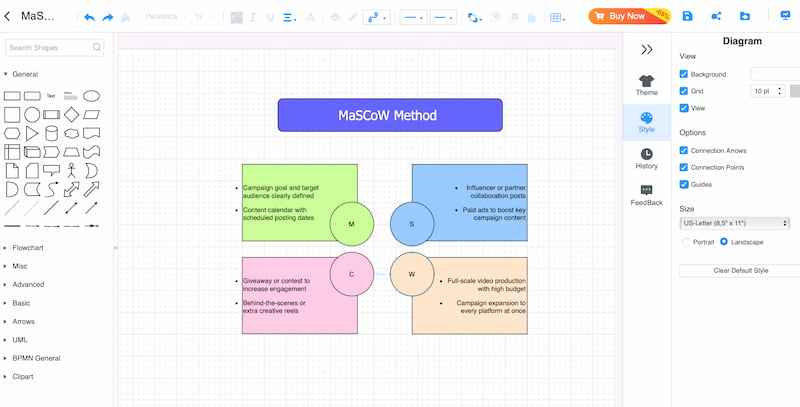
There you have it, MindOnMap indeed one of the best and useful tools for making our job done easily. We can see that we had an amazing implementation of your MoSCoW Prioritization Method with a mind map that makes it easier to understand. Therefore, worry less with managing a project as long as you have a great MaSCoW method implemented by MindOnMap.
FAQs about MoSCoW Prioritization Method
What makes MoSCoW crucial to project management?
In project management, MoSCoW is crucial because it keeps teams from concentrating on pointless activities too soon. Project managers may minimize delays, prevent missed deadlines, and produce the most useful results by appropriately prioritizing needs. By establishing clear expectations, it also enhances stakeholder communication.
Is it possible to apply the MoSCoW approach outside of software development?
Indeed, the MoSCoW approach is not limited to software development. Marketing, design, company planning, event coordination, and even personal goal-setting all make extensive use of it. This framework can be used in any situation where setting priorities and making decisions are necessary.
What typical problems arise while applying MoSCoW prioritization?
Bias in task classification is a frequent problem, particularly when important stakeholders are not participating. Teams may still require extra techniques to determine which "Must Have" tasks should be prioritized first because MoSCoW does not order priorities within each category.
Conclusion
We can now say that MoSCoW Prioritization Method is one of the best and easiest frameworks for managing tasks and projects in any project. With this, teams can utilize limited time and resources and concentrate on what is really important by classifying priorities into Must Have, Should Have, Could Have, and Won't Have categories. Additionally, it promotes stakeholder alignment, avoids scope creep, and lowers project risks. Moreover, clear and well-structured mind map visualizations make MoSCoW implementation much simpler when paired with programs like MindOnMap. All things considered, this approach is a useful tactic for accomplishing project goals successfully while preserving effectiveness and clarity.