PMP Certification: Everything You Need to Know [2026]
PMP Certification, or Project Management Professional Certification, is a globally recognized credential that validates a person's expertise in project management methodologies, practices, and leadership skills. Do you want to get more insights about the PMP certification? Then, read everything in this article since we will provide its full description, benefits, tips, and more. You will also discover an excellent tool that can help you in the PMP preparation. With that, read here to learn more.

- Part 1. An Introduction to PMP Certification
- Part 2. Overview of the PMP Exam
- Part 3. Benefits of PMP Certification
- Part 4. PMP Preparation Tips
- Part 5. Use MindOnMap to Prepare PMP Better
- Part 6. FAQs about PMP Certification
Part 1. An Introduction to PMP Certification
PMP Certification, or Project Management Professional Certification, is a globally recognized credential awarded by the Project Management Institute (PMI) to individuals who demonstrate strong knowledge and skills in project management. It attests to a professional's capability to successfully lead and oversee projects in a variety of organizational contexts and industries. Candidates or individuals must pass a demanding exam covering project management procedures and best practices in addition to fulfilling certain educational and experience requirements in order to obtain the certification. Possessing a PMP certification shows a dedication to high standards in project management, improves professional prospects, and increases credibility.
Who should get PMP Certification?
PMP certification is ideal for professionals who are actively involved in managing projects and want to validate their skills with a globally recognized credential. It is especially important and valuable for project managers, team leaders, and professionals seeking career advancement in industries where structured project management is critical. Those aiming to enhance their credibility, open doors to higher-level opportunities, and improve leadership capabilities should strongly consider getting PMP certified.
Part 2. Overview of the PMP Exam
To get more information about the PMP Exam, you can check all the details in this section.
Exam Structure
The PMP exam consists of 180 items or questions. It is a combination of multiple responses, matching, hotspot, multiple choice, and fill-in-the-blank formats. It is also divided into three main domains: Process (50%), Business Environment (8%), and People (42%), with a total duration of 230 minutes.
PMP Certification Requirements
Candidates must possess either a high school diploma or an associate degree with 60 months of project management experience. They also must possess 35 hours of education, or a four-year degree with 36 months of project management experience and 35 hours of project management education (or CAPM certification).
Knowledge Areas
When it comes to knowledge areas, the overall exam covers all necessary project management domains. It includes scope, schedule, quality, resource, integration, procurement, risk, communication, and stakeholder management. It is also aligned with PMI's PMBOK Guide and Agile practices.
Part 3. Benefits of PMP Certification
After learning what a PMP Certification is, maybe you want to learn more about its benefits. In that case, you can read everything in this part to get more insights about the benefits the certification can give.
Improved Skills
The certificate can strengthen knowledge in project management methodologies, processes, and leadership practices.
Global Recognition
It can validate your expertise worldwide. It can even make you competitive across industries.
Career Advancement
The certification can give you opportunities to advance in your career. It opens the door for promotions, leadership opportunities, and higher-level roles.
Credibility and Trust
It demonstrates commitment to professional standards. It can boost confidence among clients and employers.
Higher Salary Potential
The certificate can also let you get a better salary since PMP-certified professionals are more reliable-looking compared with non-certified individuals.
Networking Opportunities
If you are a PMP-certified professional, then you can connect with the global community of certified project managers or leaders through PMI.
Part 4. PMP Preparation Tips
Here are some practical PMP preparation tips that can help you succeed.
- • Always understand the exam content outline. You should focus on the three domains, such as people, business environment, and process.
- • You must always use the PMBOK Guide and Agile Practice Guide. These will serve as your references for getting more information.
- • Make a study plan. You should create a daily or weekly study time and break information into manageable sections for better understanding.
- • Practice with mock exams. You also need to practice answering questions. It helps you to build familiarity with question formats. It can also help you improve accuracy and speed.
- • Focus on real-world applications. Always relate concepts to your project management experience to retain knowledge.
- • You can also leverage online courses so you can have a structured program that can also offer guidance.
Part 5. Use MindOnMap to Prepare PMP Better
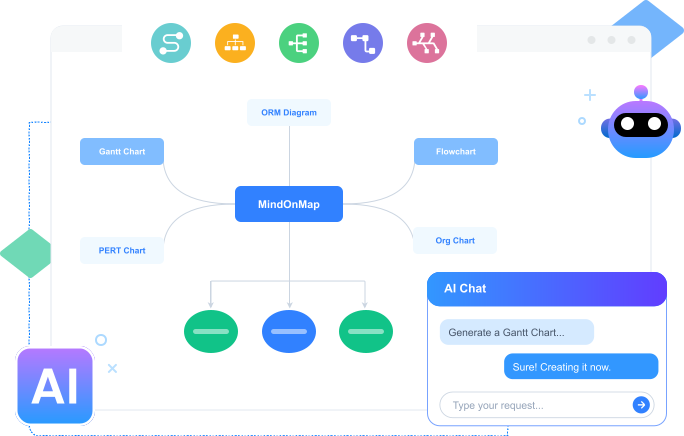
Do you want to create an understandable visual representation for exam preparation? In that case, we suggest using MindOnMap Flowchart Creator. This mind mapping tool is perfect since it can help you organize ideas, make concept maps, and study material. It lets you create structured diagrams, connect topics, and simplify complex information. The best part here is that it can also give you all the necessary elements. You can use shapes, connecting lines, colors, and more. You can even save the final visual on your device with your desired output format. Thus, if you want the best tool that can help you prepare for PMP, look no further than MindOnMap.
To learn how to use this tool, you can check the simple steps below.
Access MindOnMap and create your account. You can choose whether you want to use the tool's offline or online version.
Secure Download
Secure Download
After that, from the New section, click the Flowchart feature to see the main interface and start the process.
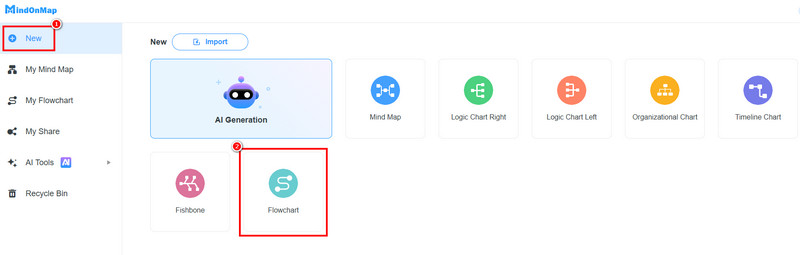
You can now create a visual representation for preparation. You can go to the General section to add your preferred shapes. Then, add text by double-clicking the shapes.
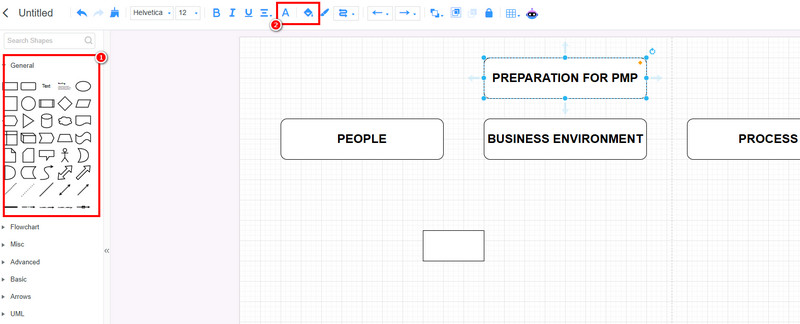
You can also go to the top interface to use the Fill and Font Color feature to add color to the shapes and fonts.
Once you are done making the visual representation, you can now hit the Save button to save it in your account. You can also use the Export feature to save it on your device in your preferred format.
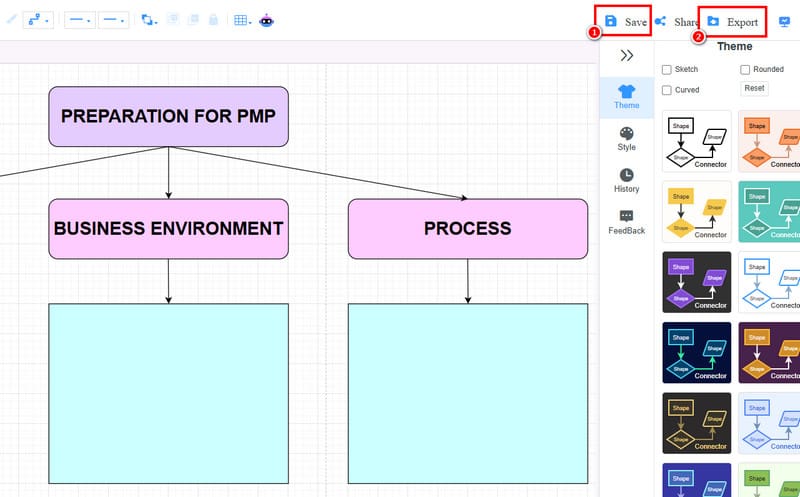
Click here to see the entire visual representation designed by MindOnMap.
Part 6. FAQs about PMP Certification
Is there a PMP certification training?
Definitely, yes. PMP training is available via PMI-authorized online platforms and providers. These courses cover Agile practices, exam strategies, and the PMBOK Guide, helping you meet the 35 hours of project management education.
How to get PMP Certification?
To get the certification, you must meet the eligibility requirements, finish the training, and apply through PMI. After that, you have to pass the exam.
How difficult is the PMP examination?
Well, we can say that the exam is challenging. It has 180 questions covering Business Environment, Process, and people domains. You must be prepared so you can pass the exam.
Conclusion
Thanks to this post, you have learned everything about PMP Certification, along with its benefits, preparation tips, description, and more. Plus, if you want to prepare for the exam, you can use MindOnMap Flowchart Creator to create the best visual representation that will serve as your guide. Thus, always rely on this tool for a better result.