Meaning & Sample of Product Launch Plan: Guide for Business
Having a great and well-structured Product Launch Plan is essential in achieving success, especially when you are introducing your product to the market. It will become your roadmap that will provide directions and guides for your business endeavor. This plan will define your objectives, strategies, and maximize impact. In this article, we will thoroughly define what a Product Launch Plan means and how you can create one. Let us make your product launch strategy effective by starting to read this post now.

- Part 1: What Is a Product Launch Plan
- Part 2: Key Stages of a Product Launch
- Part 3: Essential Elements of a Successful Launch Plan
- Part 4: Common Product Launch Mistakes
- Part 5: Best Tools for Creating a Product Launch Plan
- FAQs about Product Launch Plan
Quick Answer: A product launch plan is a roadmap for introducing a new product to the market. It outlines launch goals, target audiences, marketing strategies, budgets, timelines, and team responsibilities. A successful plan typically covers three stages: pre-launch preparation, launch execution, and post-launch evaluation to track performance and improve results.
Part 1: What Is a Product Launch Plan
Product Launch is defined as a multi-stage process that includes your pre-planning, launch execution, and monitoring of the post-launch process. In simple words, this is the detailed strategy of your plan in introducing your product to the market. This plan usually involves a timeline, budget allocation, sales goals, messaging strategy, and roles and responsibilities. In addition, the main purpose of a product launch plan is to help you establish clear objectives, improve the internal communication of your business, and generate sales.
Part 2: Key Stages of a Product Launch
As we understand more about a product launch, we shall know that it comes with three key stages of a product launch. The following are pre-launch, launch, and post-launch. Let us get to know more about these below:
Pre-launch
The pre-launch process is where you need to finalize product details, prepare new product launch marketing plan materials and elements, train your teammates, and build expectations with your target audience.
Launch
This is the day you launch your product or introduce it to the market. This is the day when your efforts will pay off, making your marketing campaigns go live, you start selling actively, and customers are getting productive.
Post-launch
The post-launch is where you gather feedback, track the activities, and make necessary adjustments if needed. This phase is important and should not be overlooked because it mostly supports the long-term success of your product launch plan.
Part 3: Essential Elements of a Successful Launch Plan
More than the stages of a product launch plan, it is also important to bear in mind some important elements to ensure the plan will be successful. Take a look at the following points:
Have Clear Goals
You need to create a clear and detailed brand launch timeline for product launch plans that include SMART goals. This will also help the whole team know what will happen with the launch process.
Know Your Target Audience
As a business owner with a plan to introduce your product to the world, you need to know that not every person will be your customer. Thus, understanding and knowing who your audience is is really important in this matter. A demographic will definitely help you improve your campaigns.
Conduct a Market and Competitor Analysis
Market and competitor analysis is another important element you should consider when starting a business. It is where you think the best things you can offer compared to the competitor. This is where your brand will stand out. Business is a wide field of competition, so you should know who your competitors are.
8-Week Product Launch Plan Sample
An eight-week product launch plan helps your team organize tasks, set deadlines, and prepare for launch day. Here is a sample timeline that you can adapt to your product, budget, and marketing goals.
| Timeline | Key Tasks | Expected Outcome |
| Week 1: Market Research | Analyze competitors, identify target customers, and validate market demand. | A clear target audience and market position. |
| Week 2: Goal Setting and Positioning | Set SMART launch goals, define your unique value proposition, and establish KPIs. (You can use mindmap for goal setting.) | Measurable objectives and consistent product messaging. |
| Week 3: Launch Planning | Assign team responsibilities, set the budget, and finalize the launch timeline. | A documented launch plan with clear ownership. |
| Week 4: Marketing Preparation | Create landing pages, email campaigns, social media content, and promotional materials. | Marketing assets ready for review. |
| Week 5: Product Testing | Test product functionality, fix critical issues, and collect feedback from beta users if applicable. | A launch-ready product and fewer potential issues. |
| Week 6: Pre-launch Promotion | Start teaser campaigns, build an email waitlist, and reach out to relevant partners or influencers. | Increased awareness and initial audience interest. |
| Week 7: Final Preparation | Check the website, payment process, customer support resources, and campaign schedule. | A final launch checklist with key issues resolved. |
| Week 8: Launch and Initial Review | Release the product, activate marketing campaigns, monitor sales and traffic, and gather customer feedback. | An executed launch and initial performance insights. |
After launch week, continue monitoring conversion rates, customer feedback, retention, and revenue against your original goals. Use these insights to prioritize improvements and plan follow-up campaigns.
Note
This is a general sample timeline. Complex products may require a longer preparation period, while smaller launches may need fewer weeks. Adjust the schedule based on product readiness, team capacity, and market conditions.
Part 4: Common Product Launch Mistakes
Having a product launch plan will not guarantee you success with launching your products. Many companies stumble because they keep making the same mistakes, especially overlooking critical details. In line with that, here are the mistakes you should be aware of to prevent them:
Poor Market Research and Analysis
We mentioned that market analysis is really important when doing business. It is how you will define the possible results and outcomes of every effort that you are making.
Weak Positioning
Having no clear objectives and product value propositions will make the customer wonder why they need to switch or purchase your product.
Not Open for Customer Feedback
Owners who do not listen to feedback will never succeed in their business. You need constructive criticism to make your product better and generate higher sales.
Overcomplicating Features
Trying to do so much all at once with your product can overwhelm customers or users. You need to remember that simplicity and clarity are more.
Part 5: Best Tools for Creating a Product Launch Plan
After knowing every important aspect of a product launch plan, let us know how to make it more effective and successful. This is just an easy process. Because a plan means a collection of information and data, that means organizing your data and information properly really helps in achieving your goals. The right product launch planning tool depends on your workflow, team size, and planning needs. Here are several options to consider.
| Tool | Best For | Ideal Team Size | Key Features |
| MindOnMap | Individuals and teams that prefer visual planning and brainstorming | 1–5 people | Mind maps, flowcharts, timelines, and visual task organization |
| Trello | Small teams managing launch tasks and deadlines | 2–10 people | Kanban boards, task cards, checklists, and due dates |
| Asana | Teams coordinating complex launches across departments | 5–20+ people | Project timelines, task dependencies, milestones, and team assignments |
| Notion | Teams that want to combine launch documentation and task tracking | 1–10 people | Custom databases, project pages, task boards, and shared documentation |
| monday.com | Growing teams managing cross-functional launch workflows | 5–20+ people | Custom workflows, dashboards, automations, and progress tracking |
Team sizes are general recommendations rather than product limits. Features and collaboration options may vary by plan.
For a simple, visual overview of your launch strategy, MindOnMap is a practical option. It offer a wide variety of elements and mind map features that you can use in visualizing your product launch plan.
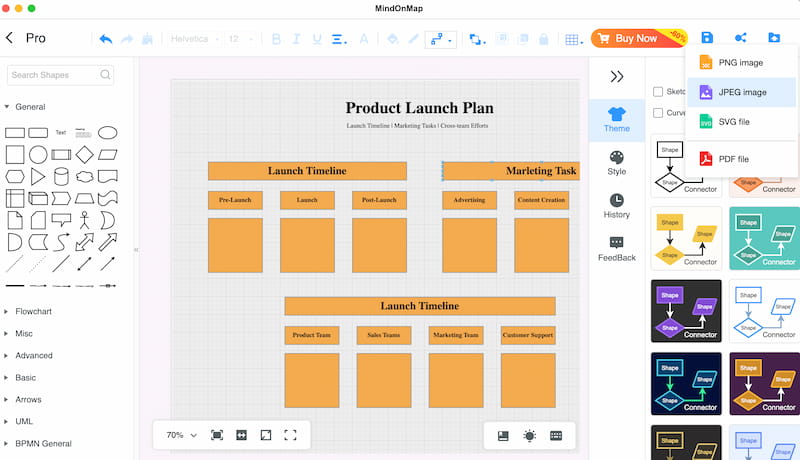
MindOnMap can easily help you map your launch timeline, organize marketing tasks, and align cross-team efforts. Here’s how you can do it.
Download and install MindOnMap on your computer for free. Then immediately launch it and access the Flowchart feature on the main interface.
Secure Download
Secure Download
We can start by adding Shapes to the clean canvas. Lay out the timeline of your plan in accordance with your preference. Ensure that you include the Pre-launch, Launch, and Post-launch stages. Use the Text button to label each stage.
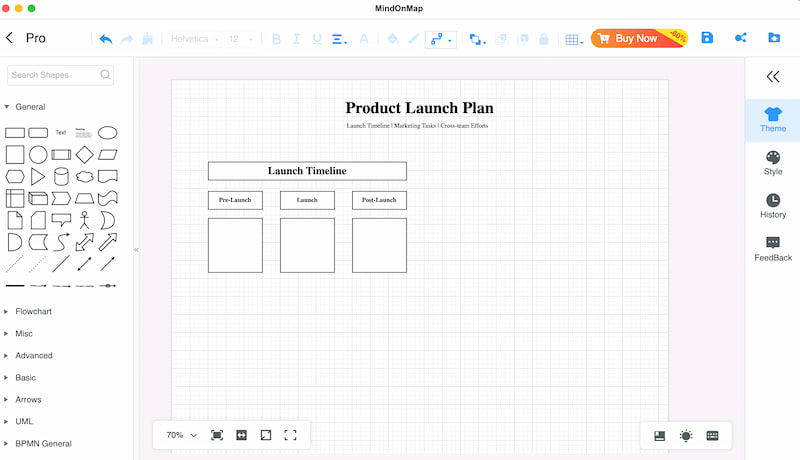
We can now organize some marketing tasks besides your timeline. It is better to use the same canvas so that you will have access to every detail you need all at once.
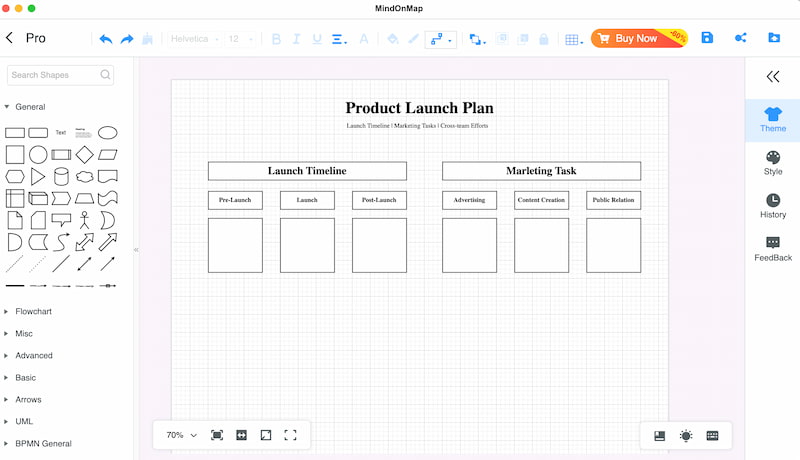
Completing the element of the plan is achieved by aligning cross-team efforts. The layout is still yours to create. Use the Shapes and Text feature also in building the map.
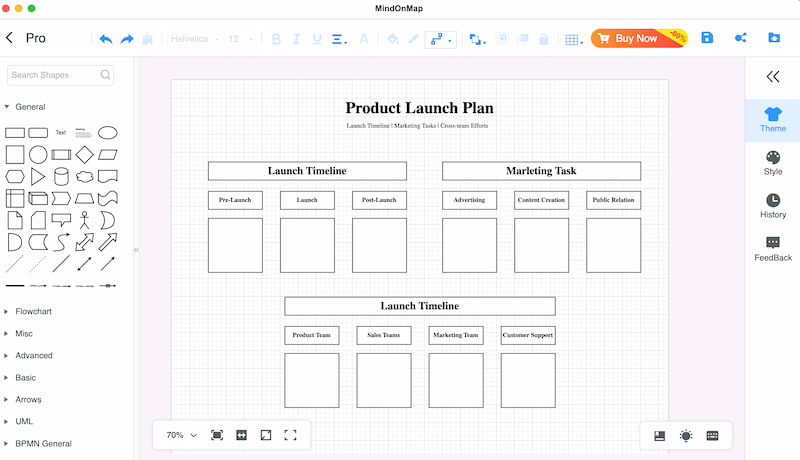
As we finalized the map, we chose the Theme to set an overall mode for the map. Then click Export to save your product launch plan map in the file format you prefer.
FAQs about Product Launch Plan
Q: How do we know the right timing for product launching?
A: It will always depend on the market situation, activities from competitors, and your preparedness. That is why market research is crucial to know when the perfect time will be for it.
Q: How can we sustain momentum after launch day?
A: You should have a strategy that will continue your marketing campaigns, feature updates, customer success feedback, programs, and building community.
Q: How can we balance hype with realistic expectations for the customers?
A: You can balance hype and realistic expectations by having controlled storytelling. You need to sell what you can offer without exaggerating it. It is always important to stay true to your product because overhyping can lead to disappointment.
Conclusion
As we get to the conclusion, we can say that a product launch plan is important when introducing your product to the world, as long as you bear in mind the important details and prevent committing the common mistakes. Good thing, MindOnMap is also here to help us manage all the information with ease.