Defining Quantitative Vs Qualitative Research With Mind Maps
Every curriculum in the academic field now has a research program, where the students are required to present and finish their research paper in one term. In line with that, we all know that there are two major kinds of research, Quantitative Research and Qualitative Research. Each one of these possess a difference of approach, method, and way of data gathering. Thus, in this article, we will get to know the comparison and difference of Quantitative Research vs Qualitative Research. Everything will become easy because in this post we will use a great mind map visual to present the information in a non-complicated way. Read these informative articles to help you start with your research program.

- 1. What is a Quantitative and Qualitative Research Map?
- 2. Quantitative vs. Qualitative Research
- 3. The Difference Between Qualitative and Quantitative using Mind Map
- FAQs about Quantitative Vs Qualitative Research With Mind Maps
1. What is a Quantitative and Qualitative Research Map?
As we start, let us first define what we mean by a Quantitative and Qualitative Research map. Basically, it is a mind map that presents every information that we need about the two types of research. This map showcases the differences, comparison, usages, and other important details about the two.
More than that, this way of studying the kinds of research is easier than reading every text in the book. As we all know, reading so much information tends to overwhelm us and lead us to not understanding what we are reading. The visuals and elements within help us understand well and understand easier every idea presented. Please continue reading the next parts as you discover one of them.
2. Quantitative vs. Qualitative Research
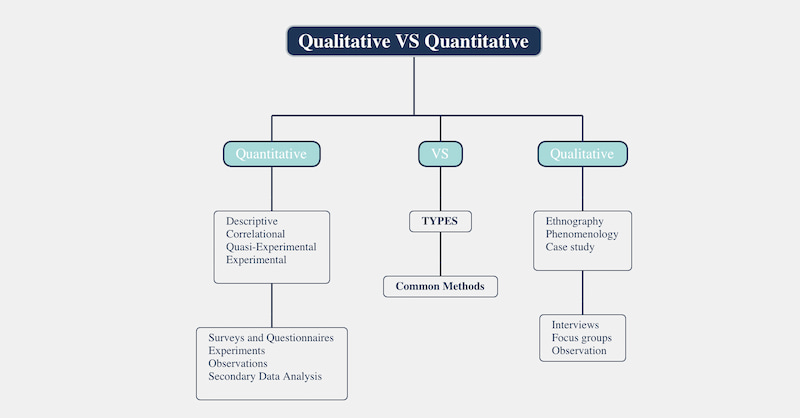
Let us now move forward and define Quantitative Research and. Qualitative Research, how approach they are, what methods they can use, pros, and cons. Take a look at the comparative mind map created by MindOnMap concept map. We can easily see different information we need to know about the differences of the two types of research. Because MindOnMap is a great tool that we can use to build and create different mind maps with ease You can use it for your projects or any maps you need for presentation or research.
Quantitative Research
Focusing on objectivity and measurable variables through instruments like surveys, experiments, and structured observations, quantitative research methodically gathers and evaluates numerical data using statistical techniques to find patterns, test hypotheses, and extrapolate results to larger populations. In contrast to qualitative research, which emphasizes non-numerical knowledge, it provides answers to how much, how many, and how often queries.

Types Quantitative Research
- • Descriptive: Explained features of a population or phenomenon example are like average age, frequency of activity.
- • Correlational: Assesses how variables relate to one another example is like does study time correlate with grades?.
- • Quasi-Experimental: Studying cause and effect in non-randomized groups is known as quasi-experimental research.
- • Experimental: Determines exact cause-and-effect by manipulating variables in a controlled environment.
Common Methods in Quantitative
- • Surveys and Questionnaires: Polls, structured forms, and closed-ended questions are used to collect large amounts of data.
- • Experiments: Changing variables in regulated environments to ascertain causality.
- • Observations: The methodical numerical documentation of actions or happenings.
- • Secondary Data Analysis: Utilizing pre-existing databases, datasets, or public documents is known as secondary data analysis.
PROS
- Produces measurable and numerical data.
- Results are easier to analyze using statistics.
- Allows comparison and generalization to larger groups.
- More objective and structured.
CONS
- Lacks depth and emotional context.
- Limited flexibility once the study begins.
- May oversimplify complex human behaviors.
- Does not explain why results occur.
Qualitative Research
Qualitative research focuses on the "why" and "how" rather than the "how many" and uses non-numerical data, such as words, audio, and video, to investigate deep understanding of experiences, attitudes, and behaviors. In contrast to quantitative research, which focuses on numerical data for statistical analysis, it employs techniques like focus groups, observations, and interviews to gain rich insights into complex social phenomena, exploring concepts, beliefs, and motivations, frequently in fields like sociology, anthropology, and health sciences.

Types of Qualitative Research
- • EthnographyI: Immersion in a culture or group to comprehend its customs and beliefs is known as ethnography.
- • Phenomenology: Using participant views to describe the core of a common human experience.
- • Case study. It is a thorough examination of a particular thing, occasion, or person.
- • Action research. It is a cooperative method for resolving a particular issue inside an organization or community.
Common Methods in Qualitative
- • Interviews: Extensive discussions to comprehend individual viewpoints.
- • Focus groups: Discussions in groups to examine common attitudes and ideas.
- • Observation: Ethnography, or observation, is the study of individuals in their natural environments.
- • Developing hypotheses based on gathered facts is known as grounded theory.
PROS
- Provides deep, detailed understanding of thoughts, feelings, and behaviors
- Captures personal experiences and meanings
- Flexible and adaptable during the research process
- Useful for exploring new or complex topics
CONS
- Results are difficult to generalize to larger populations.
- Data analysis can be time-consuming and subjective.
- Smaller sample sizes reduce statistical reliability.
- Researcher bias may influence interpretations.
3. The Difference Between Qualitative and Quantitative using Mind Map
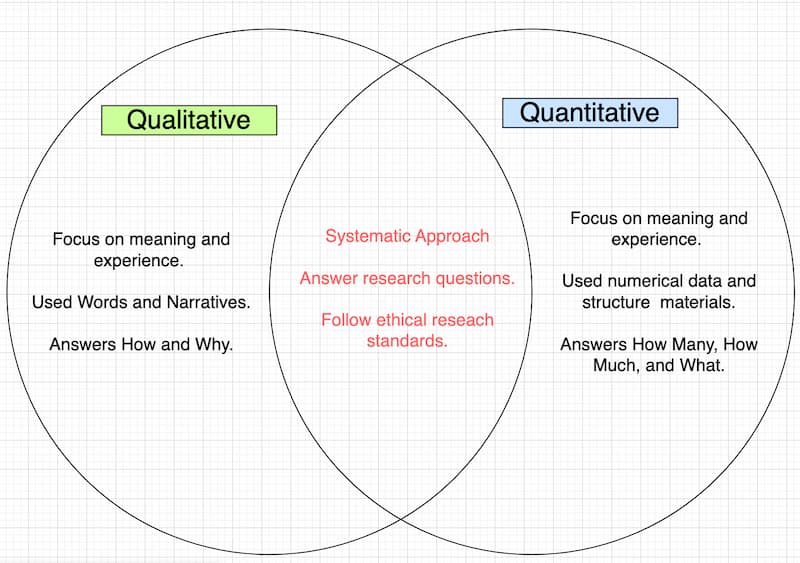
Let us use a Venn Diagram to showcase the difference between qualitative research and quantitative research yet see their similarities.
Qualitative Research (Differences)
- • Focuses on meanings, experiences, and perspectives
- • Uses words, narratives, and observations as data
- • Methods include interviews, focus groups, and case studies
- • Small sample sizes for in-depth exploration
- • Answers why and how questions
Similarities (Overlapping Area)
- • Both are systematic research approaches.
- • Used to answer research questions and test ideas.
- • Follow ethical research standards.
- • Require data collection and analysis.
- • Can be combined in mixed-methods research.
Quantitative Research (Differences)
- • Focuses on numbers, measurements, and statistics
- • Uses numerical data and structured instruments
- • Methods include surveys, experiments, and tests
- • Large sample sizes for generalization
- • Answers how many, how much, and what questions
FAQs about Quantitative Vs Qualitative Research With Mind Maps
Why compare quantitative and qualitative research using mind maps?
Complex research concepts are visually arranged in mind maps, which facilitate the understanding of contrasts and similarities. They assist students quickly understand research methodologies, tactics, and data types, lessen information overload, and enhance memory recall.
Can novices better comprehend research methodologies with the aid of mind maps?
Indeed. Mind maps assist novices understand the relationships between techniques, data types, and goals by breaking down technical research terminology into visual branches. This method makes learning the fundamentals of research less daunting and more interesting.
When is quantitative research preferable to qualitative research?
When you require numerical data, observable factors, and outcomes that can be applied broadly, quantitative research works best. It is perfect for testing theories, seeing trends, and responding to inquiries about quantity, frequency, or statistical relationships.
In what situations is qualitative research more suitable?
When investigating experiences, motives, and meanings, qualitative research is appropriate. It is most effective for in-depth research, small groups, and subjects that need thorough explanations of social interactions, beliefs, or behaviors.
Is it possible to combine quantitative and qualitative research in a single study?
Indeed. Both strategies are combined in mixed-methods research to get thorough findings. While qualitative data reveals underlying causes and offers a more comprehensive and nuanced insight, quantitative data offers quantifiable patterns.
Conclusion
Any research program must comprehend the distinction between quantitative and qualitative research. This comparison becomes more understandable when methods, data types, and purposes are shown visually through the use of mind maps. Qualitative research delves deeply into meanings and experiences, whereas quantitative research concentrates on numerical analysis and generalization. Both strategies become simpler to understand, compare, and use successfully in scholarly and professional research when combined through mind mapping.