How to Create a Nervous System Mind Map Effectively
The Nervous System's complexity, from brain and spinal cord to sensory and motor pathways, can make it a challenge to learn using text alone. A mind map solves this by turning the complexity into a well-structured visual presentation. This way, you can view the central node and its branches, making it easier to understand. In this post, we will cover everything about the Nervous System, including its description, main parts, and functions. Then, we will show and teach you how to create the best Nervous System Mind Map using an excellent tool. Read on to learn more about the discussion.
- Part 1. What is the Nervous System
- Part 2. Main Parts of the Nervous System
- Part 3. Functions of the Nervous System
- Part 4. Why Use a Nervous System Mind Map
- Part 5. Create a Nervous System Mind Map Using MindOnMap
- Part 6. FAQs about the Nervous System Mind Map
Part 1. What is the Nervous System
The nervous system is the body's main communication network. It coordinates and controls voluntary and involuntary actions. Plus, it is made up of specialized cells known as neurons. It transmits chemical and electrical signals throughout the entire body at remarkable speed. The system allows the body to sense changes in its internal and external environment and respond accordingly and appropriately.
Part 2. Main Parts of the Nervous System
Structurally, the nervous system has two parts: The CNS and PNS. To learn more about these parts, read everything in this section.
Central Nervous System (CNS)
Composed of the brain and spinal cord, the CNS acts as the body's primary hub for processing and control. The brain has three main areas. First, the cerebrum, the largest region that oversees voluntary movement, reasoning, language, and conscious thought. Second, the cerebellum, which manages balance and fine-tuned motor skills. Third, the brainstem, which controls crucial involuntary functions, including swallowing, respiration, and heart rate.
Extending from the base of the brain down through the spinal column, the spinal cord acts as a vital pathway for nerve signals moving between the brain and the rest of the body. It serves as the bridge for signals traveling between the brain and the rest of the body. It can handle simple reflex actions on its own, like instantly pulling your hands away from a hot stove, without sending the signal all the way to the brain.
Peripheral Nervous System (PNS)
The PNS, on the other hand, includes all the nerves that extend outside the spinal cord and brain. It forms a vast network that connects the Central nervous system to organs, muscles, and sensory receptors throughout the body. Also, the PNS is divided into two main subsystems. These are:
- • Somatic Nervous System – this branch controls voluntary movements by carrying signals between the CNS and skeletal muscles. It controls conscious actions such as speaking, walking, running, typing, jumping, and more. It also relays sensory information, like temperature, touch, and pain, back to the brain.
- • Autonomic Nervous System – This branch regulates involuntary functions that occur without conscious effort. It includes digestion and heart rate. It also has two divisions that work in opposition to maintain balance.
Part 3. Functions of the Nervous System
To learn more about the main functions of the nervous system, you can check the information below.
- • Receiving sensory information from the environment, such as sound, touch, smell, taste, and sight.
- • Coordinating voluntary movements, like writing, typing, and walking.
- • Regulating involuntary functions, such as digestion, heart rate, breathing, and more. Processing and interpreting information in the brain.
- • Allowing communication between various parts of the body through chemical and electrical signals.
- • Supporting higher-level functions, including learning, memory, emotion, and decision-making.
Part 4. Why Use a Nervous System Mind Map
Reading everything about the nervous system can be complicated, especially when you rely on text-based information. To make it more comprehensive, creating a mind map is ideal. So, if you want to learn more about why it is better to use a Nervous System mind map, proceed to this section.
Simplify Complicated Information
One of the main reasons to use a nervous system mind map is to simplify everything. With a well-structured visual presentation, you will understand everything, from major divisions to specific functions and structures.
Shows Relationship of the Concepts
A mind map of the nervous system can also visually connect related ideas, such as how the sympathetic and parasympathetic systems both fall under the autonomic nervous system. This is ideal for seeing the bigger picture and understanding how each part fits into the structure.
Enhance Memory Retention
Visual learning has been shown to help the brain retain information better than text-based learning alone. By arranging information into structures/branches and using colors, shapes, and keywords, a mind map creates visual cues that make it simple/easier to recall details during discussions.
Save Time for Studying or Reviewing
Once you finish creating the nervous system mind map, it can serve as a reference that shows the entire topic on a single page. It makes it quicker to review before exams or presentations than flipping through multiple pages of notes.
Part 5. Create a Nervous System Mind Map Using MindOnMap
Want to create a human nervous system mind map? In that case, we suggest using MindOnMap. This tool is perfect since it lets you visualize the nervous system based on your preferences. You can even use various connection functions to show the relationships between one idea and another. The best part is that it can help you improve your memorization by creating a well-structured visual with different shapes, colors, font styles, themes, and more. Plus, creating a mind map is simple because its user-friendly layout makes it ideal for novices. Thus, if you want to start creating a mind map of the Nervous System, see the instructions below.
Start by accessing MindOnMap in your browser. Then, tap the Create Online button. You can also use its desktop version if you want to create the mind map offline.
Secure Download
Secure Download
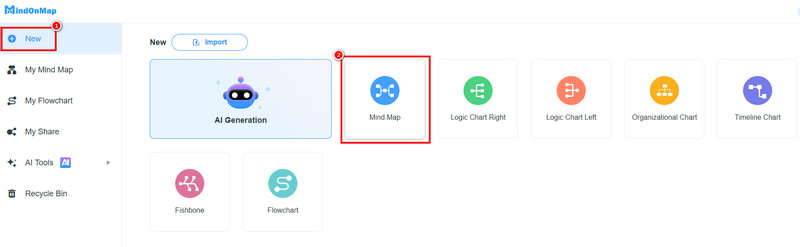
From the primary UI, proceed to the New section and click the Mind Map feature. Then, the main interface will load on your screen.
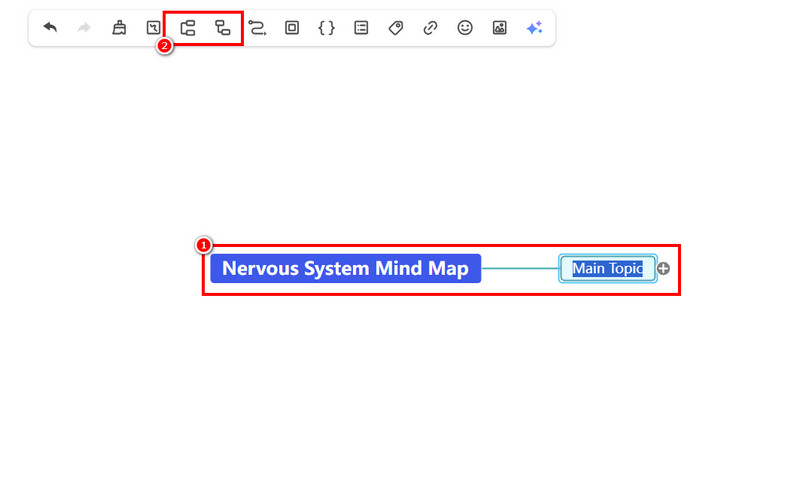
Start creating the mind map for the Nervous System. Write the main topic in the Blue box. Then, use the Sub Node function above to add more nodes/branches to your map.
After you finish, tap the Save button to save it to your MindOnMap account.
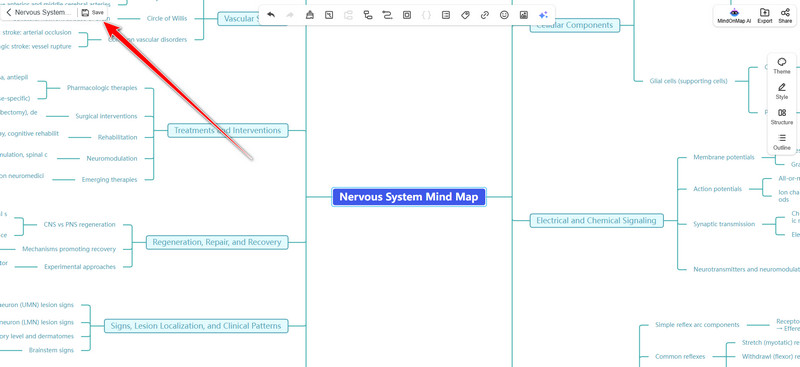
Click here to see the entire Nervous System mind map designed by MindOnMap.
Overall, MindOnMap makes it easy to create a clear and organized system map of the human nervous system. With its intuitive tools and customizable features, you can visualize key structures, connect related concepts, and improve your understanding and memorization.
Part 6. FAQs about the Nervous System Mind Map
Can I create an Autonomic Nervous System mind map?
Absolutely, yes. Creating a mind map for the autonomic nervous system is simple if you are using the right mind mapping tool, such as MindOnMap, PowerPoint, XMind, and more.
Is creating a Central Nervous System mind map recommended?
Creating a central nervous system mind map is recommended to help learners understand relationships between concepts and improve memory retention. You can also use it as a concept map to visualize how different parts and functions of the central nervous system are connected.
Is creating a Nervous System mind map easy?
It depends on the tool you use. Some tools are ideal only for professionals creating a good-looking visual presentation. If you want a simple tool that helps you create a mind map easily, we suggest MindOnMap. With its simple UI, you can access all the features without any hassle.
Conclusion
Creating a Nervous System mind map is easy with the right tool. Use MindOnMap to get the results you want quickly. Plus, if you want to learn more about the Nervous System, read this article for all the details you need, including its description, parts, and functions.