Pest Analysis: Definition and How to Do Pest Analysis
PEST Analysis is among the strategic frameworks for businesses to evaluate external factors that can influence success. It examines Political, Economical, Social, and Technological elements to guide businesses to get more insights about changes in their environment. So, if you want to learn more about PEST analysis, you must read everything in this post. We will offer its complete definition, core factors, its importance, and other necessary information. You will also learn how to create an exceptional PEST Analysis framework using MindOnMap. So, to learn everything about the discussion, check everything here!

- Part 1. What is PEST Analysis
- Part 2. How to Do PEST Analysis
- Part 3. PEST Analysis: Common Mistakes, Tips, Pros, and Cons
- Part 4. Build PEST Analysis Framework Using MindOnMap
- Part 5. FAQs about PEST Analysis
Part 1. What is PEST Analysis
PEST framework, known as PEST Analysis, is an excellent tool perfect for evaluating external environments/factors that can affect an organization or businesses. It focuses on identifying Political, Economic, Social, and Technological influences that mold organizational decisions. A real-world case study, such as Starbucks’ PESTLE analysis, can help illustrate how external factors influence business decisions. By studying and analyzing these factors, businesses can gain insights into potential opportunities and risks. This assists stakeholders and leaders in adapting strategies to still be competitive and resilient in changing markets.
Factors of PEST Analysis
If you want to learn more about the core factors of PEST Analysis, read all the information below.
Political
One of the factors in PEST Analysis is Political. It includes government policies, political stability, and regulations that directly affect business operations. For example, trade restrictions and labor regulations can alter costs, change tax laws, and affect market accessibility. Businesses or organizations must monitor political climates to anticipate risks and align effective strategies with legal requirements.
Economic
Economic factors involve overall economic growth, like inflation, exchange rates, and interest rates. They may impact/affect purchasing power, business profitability, and investment opportunities. Note that a powerful economy often boosts demand, while a poor one can force organizations to adjust pricing or cut costs.
Social
When it comes to the social factor, it covers demographics, cultural values, consumer behaviours, and lifestyle trends. Another thing that can reshape market demand is education levels, population age, and even social attitudes. Organizations and businesses that have full insights into these changes can tailor products and services to meet the target market's expectations.
Technological
Nowadays, technology is another necessary factor. It involves automation, innovation, digital transformation, and advancements in development and research. A fast technology progress can create new opportunities, disrupt industries, or render existing products obsolete. Businesses that embrace emerging technologies gain a more competitive edge and can improve efficiency.
Importance of PEST Analysis
The PEST model is necessary since it helps the organization or any business anticipate external changes. The analysis can let them align strategies with market realities and reduce uncertainties. The best part here is that it ensures businesses remain proactive rather than reactive, strengthening long-term planning and competitiveness.
Part 2. How to Do PEST Analysis
After learning what PEST is in business, you might wonder how to do one. If so, read here and learn how to do PEST analysis effectively.
Define the Scope
First, you must clarify the industry, market, or region you want to analyze.
- • Select a certain business unit or project.
- • You can also set boundaries, like local vs. global markets.
Collect Political Data
Collect data about the policies and regulations of the government.
- • You can review the tax laws, labor rules, and trade policies.
- • You must assess political stability, along with upcoming elections.
Analyze Economic Factors
After dealing with political information, start evaluating the financial trends that impact business performance.
- • Track interest rates, currency exchange, and inflation.
- • Always consider the local and global economic conditions.
Study Social trends
For the next goal, you have to study and understand both cultural and demographic shifts.
- • Examine the behaviour of the customer/consumer and the lifestyle changes.
- • Also, monitor attitudes towards sustainability and diversity.
Evaluate Technological Development
Determine innovations that can disrupt or improve operations.
- • Track automation, digital transformation, and AI.
- • Watch for emerging tools in your industry.
Interpret Findings and Apply to Strategy
After dealing with the factors, start interpreting the findings. Then, integrate them into decision-making.
- • Highlight external threats.
- • Spot opportunities.
- • Change pricing, marketing, and expansion plans.
- • Update the analysis regularly to stay relevant.
Example & Case Study
Case Study: Starbucks Expansion in India
Political
- • Favorable trade policies allowed foreign investments.
- • Local regulations required partnership with Indian firms.
Economic
- • Middle-income earners demand premium coffee.
Social
- • Urban youth embrace cafe culture.
- • Starbucks can become a lifestyle brand.
Technological
- • Mobile ordering and digital method for payments.
Part 3. PEST Analysis: Common Mistakes, Tips, Pros, and Cons
To explain PEST Analysis further, proceed to this section, as we provide some information about its common mistakes, pro tips, pros, and cons.
Common Mistakes of PEST Analysis
- • Treating the analysis as a one-time exercise instead of updating it regularly.
- • Overlooking necessary factors. Some businesses only focus on economic trends while ignoring changes in social factors.
- • Failing creating effective strategy or making good decisions after getting the findings.
Pro Tips for Effective PEST Analysis
- • When collecting information, ensure that those are from up-to-date sources.
- • For better analysis, it is suggested to customize it to your region or industry.
- • Translate insights into actionable strategies, rather than just writing factors.
PROS
- It can provide a well-structured visual, making everything understandable.
- It can help the organization or businesses anticipate risks and opportunities.
- The analysis can enhance adaptability in any environment.
CONS
- Analyzing everything is exhausting and time-consuming.
- All external factors are unpredictable, so changes appear rapidly and unexpectedly.
- If there are no actionable strategies, everything will be just superficial insights.
Want to see the differences between the PEST Analysis and SWOT Analysis? Check the table below.
| PEST Analysis | VS | SWOT Analysis |
| Helps anticipate external changes and trends. | Purpose | Identifies competitive position and strategy options. |
| Analyzes macro-environmental factors (Political, Economic, Social, Technological). | Scope | Examines internal strengths/weaknesses and external opportunities/threats. |
| Does not assess internal factors. | Limitations | Can be subjective; requires accurate data and interpretation. |
| Market entry, long-term planning, adapting to external pressures. | Use Cases | Strategic decision-making, resource allocation, competitive advantage. |
Part 4. Build PEST Analysis Framework Using MindOnMap
After learning the definition of PEST Analysis, along with its factors, importance, and other details, you might want to create an ideal framework for your business. In that case, if you want to craft a PEST Analysis framework effectively, we suggest using MindOnMap Flowchart Creator. This tool is ideal because it lets you create a well-structured framework with the help of various features. It includes shapes, lines, colors, themes, styles, fonts, and more. What we like here is that its UI is comprehensive, making it the best tool for non-professional users. It can even support a collaboration feature, making it suitable for working with other users/members of the team. Lastly, you can save your framework to different output formats, like PDF, PNG, JPG, SVG, and more. Thus, if you need the best tool for creating a framework for PEST in marketing, always use MindOnMap.
Go to the main website of MindOnMap Flowchart Creator and begin creating your account. You can also access its desktop version by clicking the button below.
Secure Download
Secure Download
After that, proceed to the New section and click the Flowchart feature. Then, the main interface will load on your screen.
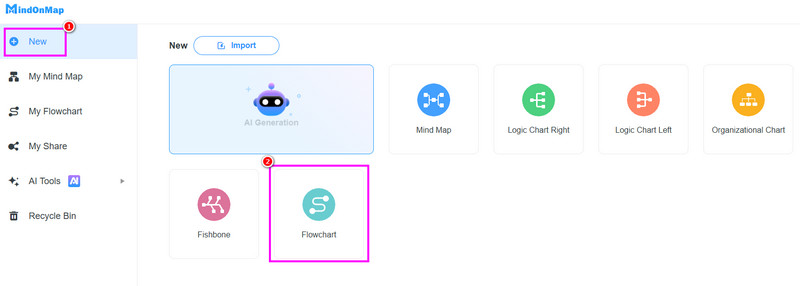
You can start creating the PEST framework. Find your desired shapes from the General section. Double-click the shapes to insert all the information.
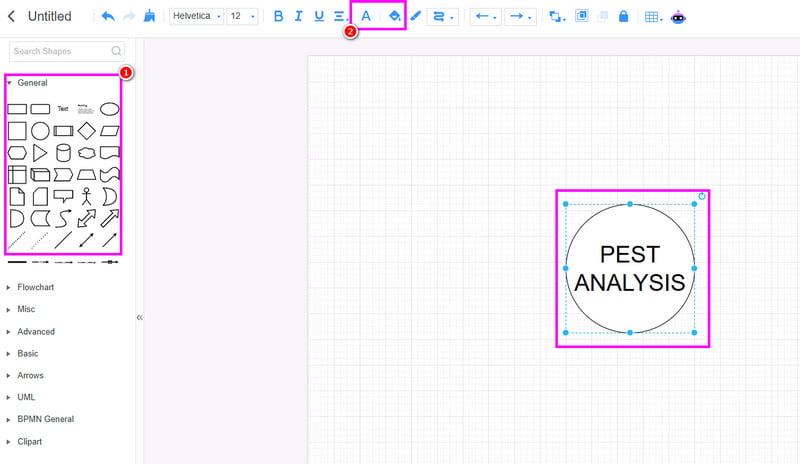
To make your framework colorful, you can use the Fill and Font Color functions above.
To start saving the PEST framework, click the Save button above. To keep it on your device, use the Export option and click your desired output format.
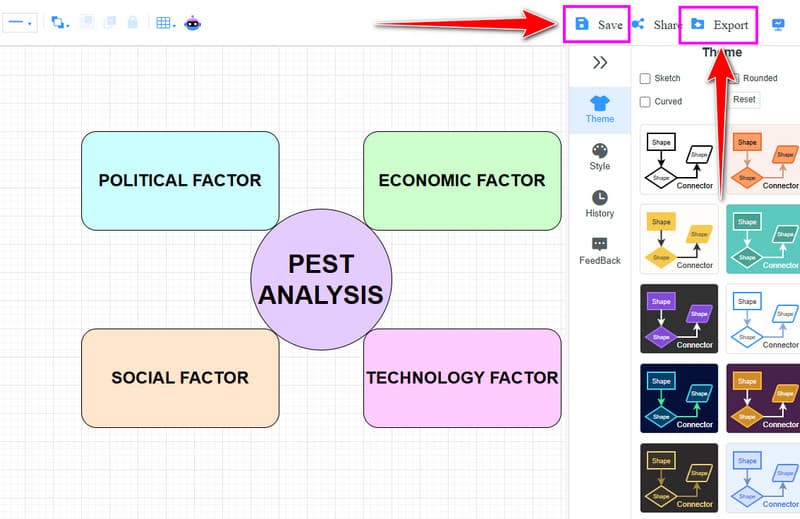
Click here to view the entire PEST framework created by MindOnMap Flowchart Creator.
Part 5. FAQs about PEST Analysis
Why is PEST Analysis important?
The good thing about this analysis is that it can help the organization and any business anticipate changes, create better strategies, and reduce the possible risks, ensuring long-term competitiveness.
When to Use PEST Analysis?
The analysis is useful for strategic planning, expansion decisions, market entry, or when the external conditions are changing.
What industries benefit most from PEST Analysis?
Some of the industries that benefit and gain the most are in technology, finance, healthcare, and international trade.
Conclusion
Thanks to this post, you have learned what a PEST Analysis is. You even explored its core factors, importance, how to do the analysis, common mistakes, tips, pros, cons, and other necessary details. Plus, you've learned how to create a well-structured PEST Analysis framework using MindOnMap. Thus, if you want to create the best visual representation that can help you view all the factors effectively, use this tool instantly!