Psychology Mind Mapping Guide and its Essence for your Field
In line with that, this article post will help you define what is the definition of Psychology and what will be the essence of a Psychology mind map. As we dig deep, we will also help you create a Psychology mind map with the help of a free tool. Read now and discover everything you need to know.

1. What is Psychology
Define Psychology
As we define Psychology, it is the scientific study of the mind and behavior with applications ranging from treating mental disorders to enhancing wellbeing and comprehending group dynamics. It investigates both internal mental processes such as thoughts, emotions, and memory and external actions using scientific methods to understand why people think, feel, and act as they do. With numerous subfields, including clinical, cognitive, developmental, and social psychology, it is a wide field that spans the social sciences, humanities, and natural sciences.
What We Study in Psychology?
- • Consciousness, perception, attention, emotion, intelligence, motivation, and personality are examples of mental processes.
- • Behavior includes observable behaviors, interactions between individuals and groups, and the relationship between these behaviors and mental states.
- • Influences include societal influences, environmental circumstances, genetic predispositions, and biological elements or brain chemistry.
Principal Objectives of Psychology
- • To Learn: Discover the fundamentals of animal and human behavior and mental processes.
- • To Explain: Identify the reasons for actions, ideas, and feelings.
- • To Predict: Make predictions about how people would act in particular circumstances.
- • To Change or To Improve: Create treatments and methods to deal with mental health problems and improve life quality.
2. Draw a Psychology Mind Map with MindOnMap
What is a Psychology Mind Map
In order to enhance comprehension, memory, and creativity for studying, brainstorming, or problem-solving, a psychology mind map is a visual aid that arranges psychological concepts, theories, and ideas around a central theme using a hierarchical, branching structure that mimics the brain's natural associative thinking. It makes difficult psychological subjects more approachable and engages the entire brain rather than simply linear reasoning by using visuals, colors, and keywords to make connections.
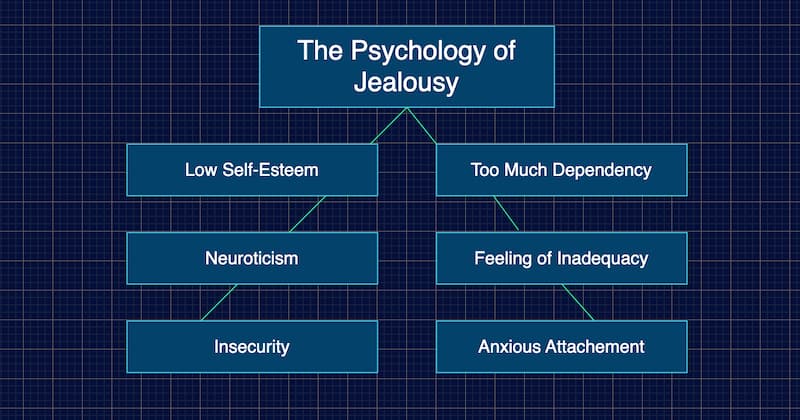
How to Create a Psychology Mind Map
After we discover the definition of both Psychology field and a Psychology mind map, we are pretty sure that you are now interested to know how to create your own mind map for a simple way to study every concept and idea you need. Well, in this part, allow us to introduce you to MindOnMap. This is a great tool that helps users in creating different kinds of mind maps including your Psychology mind map. It offers various features such as an Ai integrated system, user-friendly interface, free tool, and more. All of these can help you have an easier process of mapping Psychology ideas. Let us now understand how we can use it with ease below:
Go to the main website of MindOnMap, and download the tool for free. After that, you can now install it on your computer immediately.
Secure Download
Secure Download
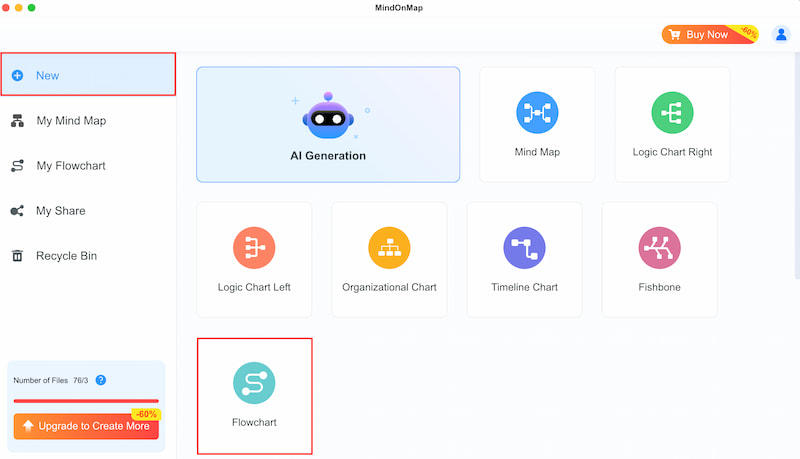
Open MindOnMap on your computer to see its interface. From there, click the New button. Then see the Flowchart feature among the options.
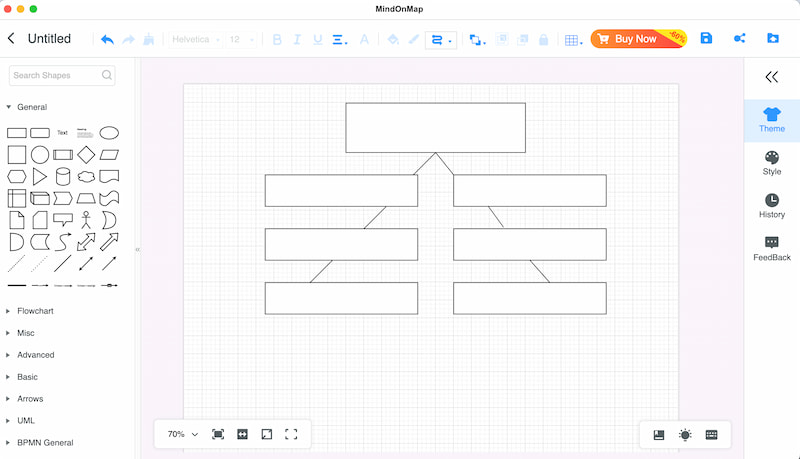
It will now lead you to its editing interface where you start everything. You can now start using the Shapes. You can arrange the overall look of it by adding enough shapes for details of your Psychology mind map.
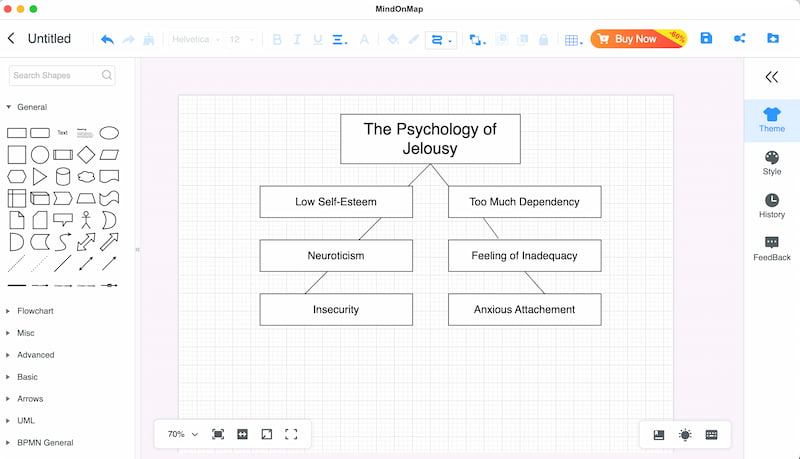
Now, let us add the Text which will be the details of our mind map. In this situation, we will use the Psychology of Jealousy as an example. Ensure that you have all of the details you need and they are properly researched.
To give a final touch for your map, go to the Theme and select your preferred looks. Then after that, please click the Export button and save the map in your preferred format.
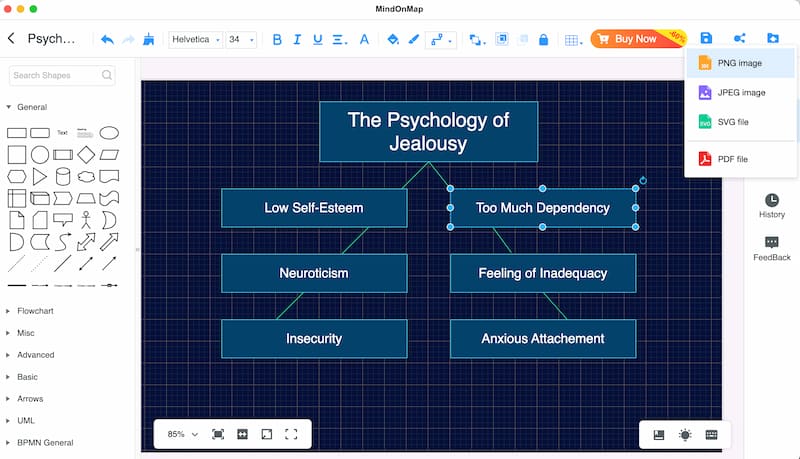
That is the simplest way to create a Psychology mind map, we can see that MindOnMap made everything easy for us. The tool is really helpful with its features. Everything is a few clicks to use. Get MindOnMap now!
3. FAQs about Psychology Mind Map
What is a psychological mind map's primary objective?
A psychology mind map facilitates the visual organization of complicated psychological ideas. By presenting connections between theories, concepts, and mental processes in an approachable manner, it enhances comprehension, memory retention, and critical thinking.
Who can use a mind map for psychology?
Psychology mind maps are useful for researchers, educators, students, and psychologists. They are particularly helpful for students who wish to simplify complex theories, get ready for tests, come up with ideas for research projects, or more successfully explain concepts.
What subjects are suitable for a psychology mind map?
Cognitive processes, behavior, emotions, mental diseases, therapeutic techniques, brain functions, and psychological theories can all be included in a psychological mind map. Clinical, social, developmental, and cognitive psychology are some of its subfields.
How may learning be enhanced by a psychological mind map?
A psychology mind map stimulates both sides of the brain by fusing keywords, colors, and visual connections. This approach facilitates active learning, improves recall, and facilitates the logical understanding and connection of abstract psychological concepts.
Can novices make a psychological mind map with ease?
Yes, using programs like MindOnMap, novices can make a psychology mind map with ease. Users may concentrate on ideas without worrying about intricate design stages thanks to drag-and-drop functionality, pre-made templates, and straightforward editing options.
Conclusion
A psychology mind map is an effective teaching tool that organizes and visualizes difficult theories and concepts. By organically integrating concepts, it promotes deeper comprehension, improved memory, and more effective study. Making a psychology mind map can make learning easier and increase productivity for anyone, including professionals, educators, and students. The process becomes simple and approachable with the use of tools like MindOnMap, which facilitates the exploration and mastery of psychological information.