What Are Creative Techniques: 6 Types & How to Organize Ideas
Quick Answer
Creative techniques are structured methods to spark innovation and solve problems. Common types include brainstorming, SCAMPER, Mind Mapping and Six Thinking Hats. They apply to marketing, product design, education and business. You can organize generated ideas visually with tools like MindOnMap.
A way to spark originality is to have structured creative techniques. This method can guide you in solving problems and enhancing innovation across your fields. The process of having a technique for creativity includes brainstorming and mind mapping as you get the framework. All of these actions and methods are useful for generating ideas and organizing your thoughts effectively. For that, join us in this article as we navigate all of the important details about this method and how a tool like MindOnMap can help you use your full creative potential.

- Part 1: What Are Creative Techniques?
- Part 2: How to Use Creative Techniques
- Part 3: Common Mistakes, Tips, Pros and Cons
- Part 4: MindOnMap: Organizing Creative Methods
- FAQs about Technique Creative
Part 1: What Are Creative Techniques?
Creative Techniques Definition
The process of creative techniques is known to be a systematic approach that exists to foster content originality, innovation, and even imagination. This process is a great help for individuals when it comes to generating new ideas, exploring alternative insights, and even solving problems in unconventional ways. Note that this approach is not only for creating a novel concept, but it also ensures that your ideas are useful and impactful, regardless of the medium of literature you are going to make. In addition, it also makes sure that the concept will be adaptable in any field.
Types and Their Purposes
- • Brainstorming. The process of generating ideas in a group setting, but it also applies to individual processes. Since 2024, AI-assisted brainstorming has grown popular. Teams can use LLMs to generate SCAMPER style idea variants quickly. The AI expands prompts and explores angles, while human participants filter, validate, and refine the most valuable concepts from a design thinking workshop. You can capture and organize these AI augmented ideas in MindOnMap.
- • SCAMPER. This type stands for Substitute, Combine, Adapt, Modify, Put to other use, Eliminate, and Reverse. SCAMPER works best for groups of 3–6 people and typically runs for 45–60 minutes; it also works well for solo ideation.
- • Mind Mapping. It is where you turn your ideas into a visual organizational process.
- • Six Thinking Hats. This is the structure of Edward de Bono, which is role-based thinking. Six Thinking Hats suits teams of 4–10 participants, with a standard session length of 60–90 minutes.
- • Improvisation. It is a spontaneous process of creating art.
Part 2: How to Use Creative Techniques
Step-by-step Method of Using Creative Techniques
You need to define and have a clear challenge or goal.
After that, you need to select the types of techniques you are going to use for your creative process.
It is now time to generate ideas. As a quick tip, you just need to allow yourself to have a free flow of thoughts without judging them quickly.
The next step will be organizing and refining the draft from brainstorming. Here, you need to evaluate the ideas properly.
After refining the ideas, you are now about to apply and implement the best ideas you created. Put it into practice now.
Until the end, reviewing the outcomes is necessary. You need to know the effectiveness of your approach and what needs adjustment.
Examples and Applications of the Method
- • Marketing: Brainstorming ideas for campaign slogans.
- • Product Design: Using the SCAMPER approach to modify the new feature for the gadgets.
- • Education: Mind mapping ideas and structuring lesson plans for teachers.
- • Business: Using Six Thinking Hats in evaluating a new strategy from different perspectives.
- • Theater: Writing a dialogue or playwriting in the moment of playing.
Part 3: Common Mistakes, Tips, Pros and Cons
Common Mistakes in Using Creative Techniques
- • Overcomplicating the Process. Having a lot of techniques simultaneously can dilute your focus.
- • Blocking Collaboration. The absence of collaboration in the process can limit your creativity and idea generation.
- • Rigid Thinking. Focusing on fixed rather than using flexible tools.
- • Skipping Evaluation. Skipping the process of refining them is a real mistake.
Practical Tips
- • Have Clear Goals. You need to clearly set a goal before starting.
- • Technique equals Context. You need to use the technique or type that will match your concepts.
- • Creativity and Analysis. These two elements should be balanced.
- • Review and Adapt. You need to assess the outcome and the good effects of the approach.
Pros and Cons
PROS
- It can enhance your creativity.
- Improved collaboration within the team.
- It gives structured creativity.
- It contributes to your personal growth.
CONS
- This approach is overly reliant on tools.
- There are implementation challenges.
- The outcome might be unpredictable.
- Time-consuming to create.
Part 4: MindOnMap: Organizing Creative Methods
We are now equipped with general knowledge about creative techniques. We basically get to know that it is a useful approach in enhancing our way of being creative. That is why, in this part, we will help you turn those ideas into visualized material. Creativity is boosted when using visual arts. Good thing, MindOnMap is here to help us create a visual version of your creative technique. Let us now discover its tools and features that can help us make this possible.
Step-by-Step Guide to Using MindOnMap
Get the amazing tool MindOnMap from its official website. This tool is free, so ensure that you install it immediately on your computer.
Secure Download
Secure Download
After that, open the tool and access its main interface. From there, see the Flowchart feature. This can help you create visual material for your creative technique.
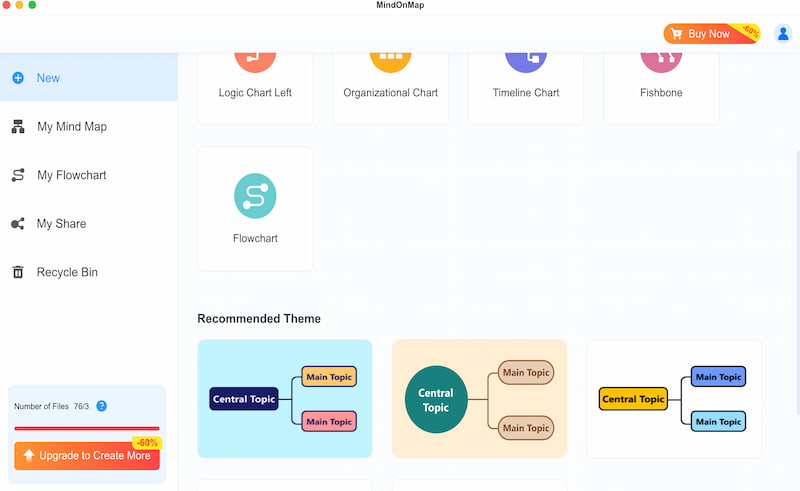
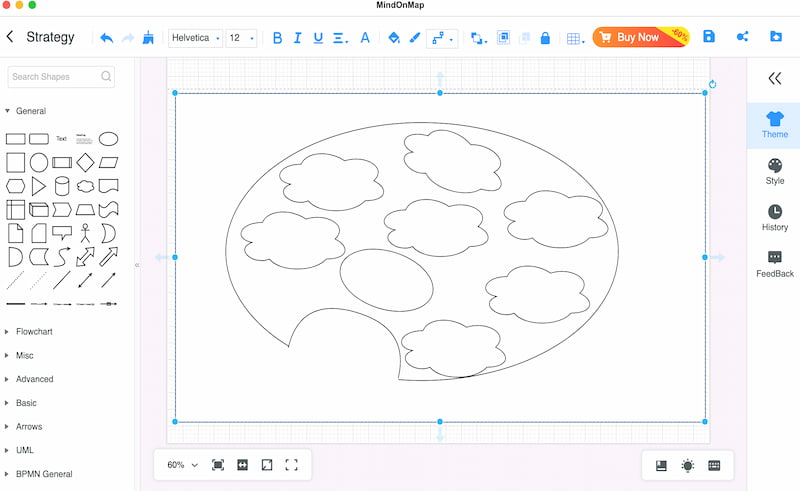
On the blank canvas, you can now start the layout of your visual materials by adding Shapes. Start placing the elements one-by-one depending on the approach you need.
Let us now add depth to your visual. Use the Text feature. Ensure that you add every bit of your ideas.
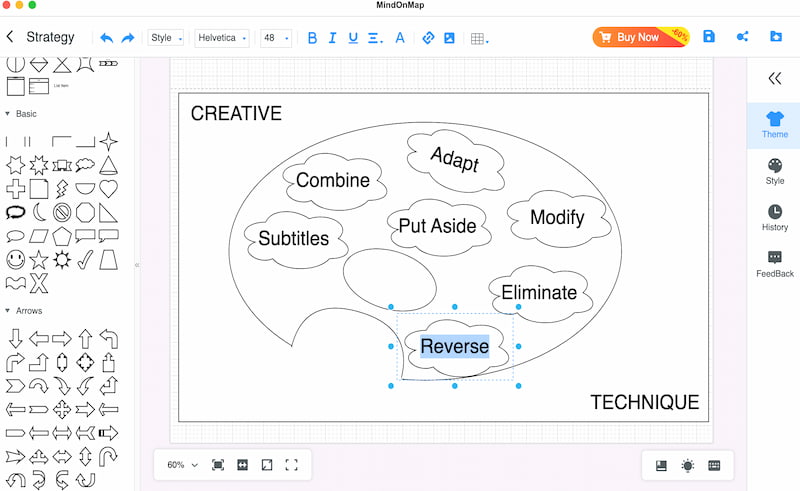
Finalize your visual by adding the Theme. This will set the overall tone and look of your presentation. If you are done, you can now click Export the design and save the file format you need.
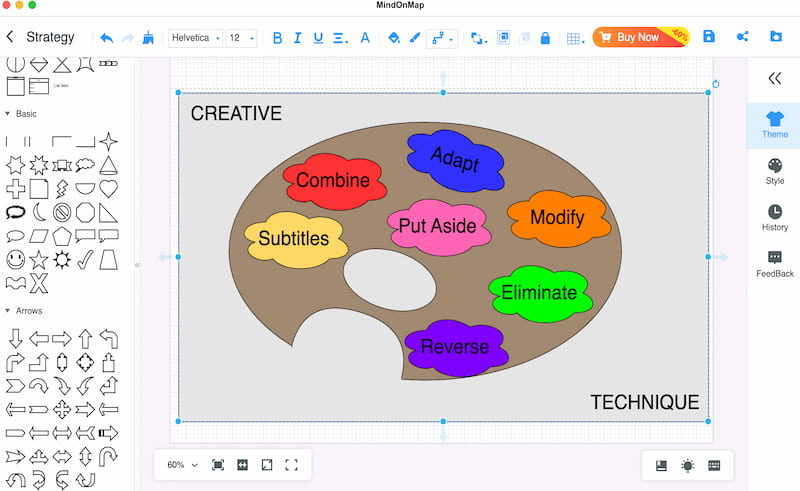
That is the power of MindOnMap in creating our ideas into visual materials. We can also see that the tool is easy to use but effective. The best thing about it is the fact that it is free. Get it now and allow yourself to be creative.
FAQs about Technique Creative
Q: What technique can I use for a product design?
A: If you are about to create a product design, you need to use SCAMPER, which can ensure an effective way to manage your process. That is possible because this is known to be a systematic way of modifying the details of a product via substituting, combining, and even adapting features for innovation.
Q: How can I use mind mapping to improve my team’s collaboration?
A: Mind mapping lets the whole team work on a shared canvas. Members can leave comments on branches and track version changes together, so everyone builds and sees connections as a group.
Q: Can I use creative techniques in my education?
A: Yes. You can use techniques such as role-play and improvisation to enhance students' engagement. This can also give us great retention of complex concepts.
Conclusion
This is now the conclusion of this article, where we proved that creative techniques are a great method for us to be more creative. We also see that this can be applied to any field such as education, theatre, and more. In addition, being creative can be more effective once you turn it into a visual material using MindOnMap. This is free, and you can get it now on their official website. Get it now for your computer.