How to Run an OKR Workshop: Set Objectives and Key Results
Quick Answer
An OKR workshop is a collaborative session for teams to co create qualitative Objectives and measurable Key Results. It aligns team work with company vision, clarifies priorities, and avoids overcommitment. Follow structured steps to run the session and watch for common pitfalls. You can document and visualize OKR outputs with flowchart based tools like MindOnMap.
Aligning measurable goals of the team can be done by using an OKR Workshop. This is a powerful tool that showcases every fundamental you need in achieving goals via collaboration. That is why this article will help you navigate all of the essential things about it, like its definition, purpose, and the basics of the Objectives and Key Results framework. In addition, we will highlight the common mistakes you should avoid and practical tips you can follow to be effective with your OKR workshop. Lastly, we will get to know the amazing tool MindOnMap and how it can help us create visual materials for it with ease.

- Part 1: What is an OKR Workshop?
- Part 2: How to Run an OKR Workshop
- Part 3: Common Mistakes, Practical Tips, Pros and Cons
- Part 4: MindOnMap to Plan OKRs
- FAQs about OKR Workshop
Part 1: What is an OKR Workshop?
OKR Workshop
As we define the OKR Workshop, it is about the process of collaborating and conducting a session where all of the teams will co-create. This is where they will brainstorm about objectives, such as the ambition and their qualitative goals. Also, the Key Results, if it is specific and measurable outcomes. One of the big differences of this approach compared to the traditional one is its ability to emphasize the alignment of ownership, clarity, and ensuring common ground with everyone.
Purpose of OKR Workshop
We shall now give you an overview of its purposes and how this approach can benefit you:
- • It connects the company vision to the team execution properly.
- • Sets the priority and defines what matters the most for the team.
- • Turns goals into trackable results.
- • Avoids overcommitment and can keep the team aligned all the time.
OKR Basics
| Element | Definition | Example |
| Objective | Qualitative statement of what to achieve. | Become the go-to partner for accessible civic technology in Latin America. |
| Key Result | Specific, measurable, time-bound indicator of success. | • Launch in 3 new countries by Q3. • Achieve NPS of 60+. • Reduce onboarding time to under 2 days. |
| Initiatives | Concrete projects driving Key Results. | Automate onboarding and expand regional partnerships. |
Part 2: How to Run an OKR Workshop
Steps on How to Run an OKR Workshop
You have to set a clear purpose. It is important to define your workshop goals with clarity.
After that, please gather participants. This can include the leaders, managers, and contributors.
Ask your team to brainstorm the objectives together. You need to collect ambitious and qualitative goals.
You can now define the key results by translating the objectives into measurable outcomes.
We can now align and finalize each detail. In this step, you need to review your OKRs with the strategy, prioritize initiatives, and document them.
Examples and Templates
| Team | Objective | Key Results | Initiatives |
| Marketing | Increase brand awareness. | Grow social followers by 30% and achieve 50K monthly blog visits. | Launch content calendar and run influencer campaign. |
| Product Development | Deliver a high‑quality product release. | Ship v2.0 by Q3 and reduce bug backlog by 40%. | Sprint planning and QA automation setup. |
| Sales | Boost quarterly revenue. | Close $2M in new deals and increase conversion rate from 15% to 25%. | Improve demo scripts and expand outreach campaigns. |
Part 3: Common Mistakes, Practice, Tips, Pros and Cons
Common Mistakes
- • Having too many objectives can prevent you from focusing.
- • Vague key results will let you have a poor time management in the progress.
- • Never track the results or progress.
- • There is confusion between initiatives and results.
Practical Tips
- • You can limit the objectives to three to five per team cycle.
- • Use numbers and deadlines to make the key results measurable.
- • You need to maximize collaboration for better teamwork.
- • Tracking progress is needed monthly or even quarterly.
Pros and Cons
PROS
- Ensures company vision connects to team goals.
- Priorities are transparent and measurable’
- Teams co‑create and own their OKRs’
- Prevents overcommitment and distractions.
- Progress tracked with clear metrics.
CONS
- Can feel forced if leadership isn’t engaged.
- Risk of oversimplifying complex goals.
- Time‑intensive workshops may slow execution.
- Narrow focus may overlook emerging opportunities.
- Pressure if results are unrealistic or poorly set.
Part 4: MindOnMap to Plan OKRs
We are now aware of every detail about the OKR Workshop. We can see how it can be a great method for allowing the whole team to collaborate with ease. Thus, turning all of these ideas, objectives, and key results into visual materials is a great way to make the observation of progress easy. It's a good thing we have MindOnMap mind in this era, where we can use its full features for creating a clear and presentable workshop board. In this part, we will show you how easy it is to use and how effective it is for your project. See the steps below:
Download and install MindOnMap from their official website now. This is free, and you can get it now.
Secure Download
Secure Download
Open the tool on your computer and access its main interface. Get the Flowchart feature now. It will help you create a map with full control.
You can now add shapes to your canvas as you start the main foundation of your map. Add as many shapes as you need.
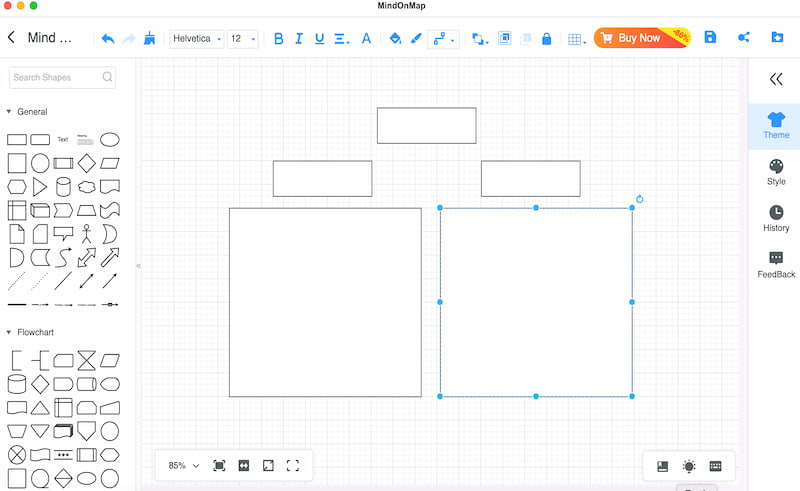
Let us now add the details on each shape using the Text feature. Ensure that you are adding the correct details. Then you can build connections with each detail using the Arrow element.
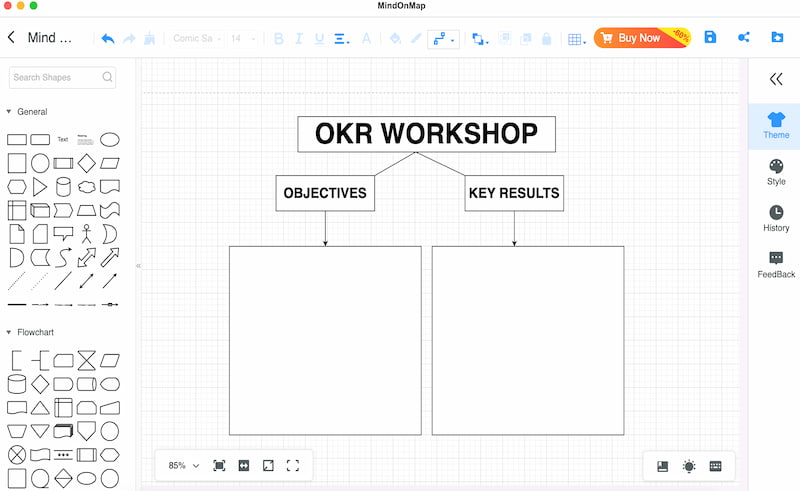
Review the material, then set the overall look using the Theme. Finally, save it by clicking the Export button and saving it in your preferred file format.
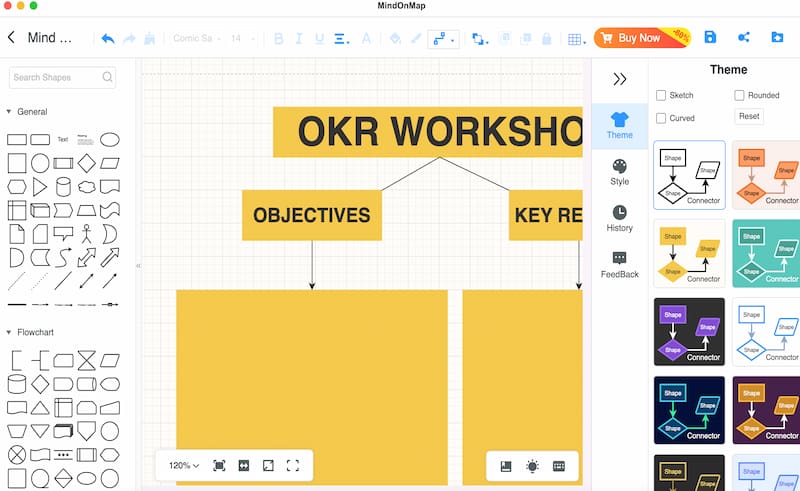
That is the ability of MindOnMap to turn our OKR workshop into a visual presentation. We can now use it for free. This is a simple-to-use tool, so anyone can use it without prior knowledge of any editing platform.
FAQs about OKR Workshop
Q: How many OKRs are recommended per quarter?
A: The team should have one to three objectives per quarter. Each objective should also have two to four key results. Having more than five might dilute the focus and reduce the impact of the project.
Q: Is there a difference between OKRs and KPIs?
A: Yes. Your KPI can track your ongoing operational health. OKRs are an approach that can measure your direction changes. You should not confuse the two. Note that OKRs are decoupled from individual performance ratings. This is the classic Google approach, designed to remove fear and motivate teams to set stretch goals. A low OKR score does not automatically equal poor performance.
Q: How often should we do an OKR workshop?
A: You need around one per quarter. This should be aligned with the OKR cycle. Yet, mid-cycle check-ins are the moment when you need to adjust your initiatives and track progress.
Conclusion
In conclusion, you can now see the fundamentals of the OKR workshop and why it is important for effective collaboration with the team. We also run down some common mistakes to avoid and tips to follow to make it more effective. In addition, we have MindOnMap, which offers great features that can help us create a visual presentation of all the details you need. It is free, and you can use it now.