Theory of Constraints (TOC): A Comprehensive Guide
The Theory of Constraints, also known as TOC, is a management philosophy that focuses on determining the most critical limiting factor or 'constraints' that hinder a corporation's capability to obtain or achieve its goal. Plus, by improving this constraint systematically, organizations can unlock better productivity, efficiency, and growth. If you want to learn more about the Theory of Constraints, you must visit this post. We will give you its perfect definition, focusing on steps, applications, and common misunderstandings. Lastly, we will teach you how to organize all the information using an exceptional tool. Check this post and explore more about TOC.

- Part 1. An Introduction to Theory of Constraints
- Part 2. The Five Steps of Theory of Constraints
- Part 3. Application of the Theory of Constraints
- Part 4. Common Misunderstandings about the Theory of Constraints
- Part 5. Comparison of Theory of Constraints and Lean Thinking
- Part 6. Organize All Information Using MindOnMap
- Part 7. FAQs about the Theory of Constraints
Part 1. An Introduction to Theory of Constraints
The TOC, or Theory of Constraints, is a management approach that focuses on finding and addressing the single most limiting factor, also known as 'constraint.' It prevents a system from reaching its full potential. TOC was introduced by Eliyahu M. Goldratt. It highlights that each procedure has at least one bottleneck that dictates the overall performance. By focusing on the improvement of these constraints, organizations can obtain significant gains in efficiency and output. To make it short, the Theory of Constraints offers a structured method to maximize results by tackling the weakest link in the chain.
Why Constraints Limit Performance?
It is because they function as bottlenecks that restrict the flow of work, resources, or information inside a system that constraints limit performance. The total output cannot exceed the constraint's capacity, regardless of how well other process components operate, when resources are allocated to non-critical areas rather than the actual limiting reason, inefficiencies, delays, and wasted effort result. Organizations can eliminate obstacles to expansion and guarantee that advancements produce significant outcomes by recognizing and controlling restrictions.
Part 2. The Five Steps of Theory of Constraints
For better Constraints management, there are five focusing steps you have to consider. These are:
Identify the Constraints
Identifying the Constraints is the very first step of the five steps associated with TOC. Its main focus is to identify the part of any system that is limiting the abilities of an organization to reach its goal.
Exploit the Constraints
After identifying the constraints, the next process is to determine how to leverage them. Exploiting the Constraints means maximizing productivity. It is also to ensure that the constraint is being utilized to its full potential.
Subordinate Everything Else
Focusing on the non-constrained process is the objective of the subordination step. Any non-constraint process should ideally follow the conventional route of having at least some surplus capacity. The full use of the constraint itself is made possible by this excess.
Elevate the Constraints
For the fourth step, you can now elevate the Constraints. Any resources used to resolve the limitation must be increased once the productivity level at the constraint itself has been maximized. Increasing the system's throughput is the primary objective here.
Repeat the Steps
For the fifth and the last step, the best thing to do is to repeat the step. You have to look back to see if the constraint is still broken. If so, then you are doing a great job. You must take note that another constraint will likely exist. If that happens, all you need to do is repeat the process.
Part 3. Application of the Theory of Constraints
After defining the Theory of Constraints, you can also see the details below and learn more about its applications.
Manufacturing and Production
- • The TOC allows you to identify the production bottleneck.
- • You can schedule work to maximize throughput to the constraint.
Supply Chain Management
- • TOC lets you pinpoint the lowest link in the supply chain, such as supplier capacity, transport, and warehouse.
- • It lets you synchronize logistics and inventory around the constraint.
Project Management
- • You can focus on the longest chain of dependent tasks.
- • You can cover and protect the schedule with a buffer at critical points.
Sales and Marketing
- • You can recognize the constraint in demand generation. Some examples are sales team bandwidth and lead conversion rate.
- • You can use TOC to align campaigns and resources to strengthen the weakest link in the funnel.
Part 4. Common Misunderstandings about the Theory of Constraints
Even knowing the types of constraints, there are still some people who have a common misunderstanding about it. With that, to give you more information, you can check all the details below.
The Goal of TOC
cReality: The main objective of TOC is ongoing improvement. It is a continuous journey toward maximizing profitability, resilience, and impact.
Focus on Throughput
Misunderstanding: The main purpose is to increase throughput.
Reality: Throughput is a leverage point. The main goal is cash flow, ROOI, and higher net profit.
Bottleneck Fixation
Misunderstanding: TOC is only about finding and fixing bottlenecks.
Reality: It is about systematic improvement and ongoing identification. It is not just a one-time fix.
Part 5. Comparison of Theory of Constraints and Lean Thinking
Want to see the difference between Theory of Constraints and Lean Thinking? Then, you can check the simple table below.
| Theory of Constraints | vs. | Lean Thinking |
| Maximize system throughput by managing the constraint. | Goal | Eliminate waste and maximize customer value. |
| Throughput (output rate of the system). | Primary Measures | Value stream efficiency, waste reduction, and flow. |
| Systems with a clear bottleneck limiting performance. | Best Use Case | Complex processes with multiple sources of waste. |
| • Identify, exploit, and elevate the constraint. • Non-constraints are secondary. | Improvement Focus | Continuous improvement across all processes, focusing on waste elimination. |
| Five Focusing Steps (Identify, Exploit, Subordinate, Elevate, Repeat). | Tools/Methods | Value Stream Mapping, Kaizen, 5S, Kanban, Just-in-Time, and more. |
Part 6. Organize All Information Using MindOnMap
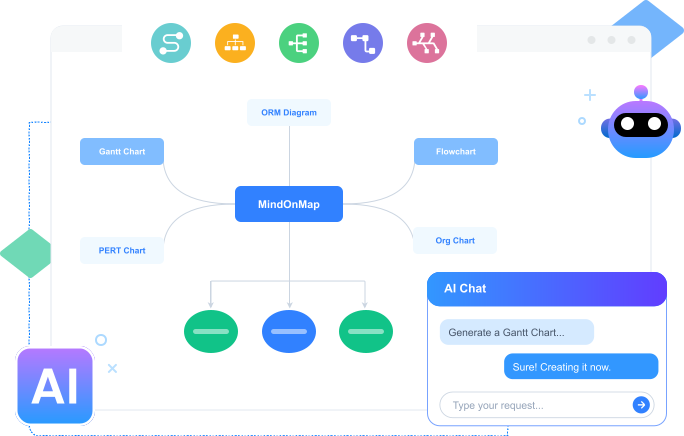
Do you want to organize all the information for better viewing and learning? Then, we suggest using MindOnMap Flowchart Maker. This tool is ideal since you can organize all the details based on your preferences. You can also utilize various shapes, lines, colors, styles, and more. What makes it the best data organizer is its simple and easy user interface. You can achieve your main objective without encountering any difficulties. What we like here is that you can save your final work in various formats, such as PNG, JPG, PDF, SVG, and more. With that, if you need a reliable tool that can help you organize all the information, always consider using MindOnMap.
To start organizing all the information, use the method below.
First, you can download MindOnMap on your computer. After you launch it, start creating your account.
Secure Download
Secure Download
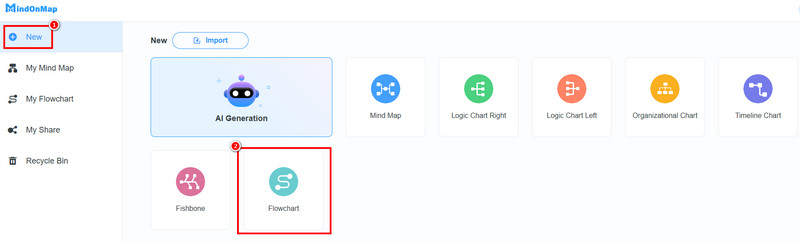
From the layout, go to the New section and click the Flowchart feature. Then, the main interface will start to load on your screen.
You can start organizing all the information. Go to the General section and use your preferred shape. Double-click the shape to insert the text.
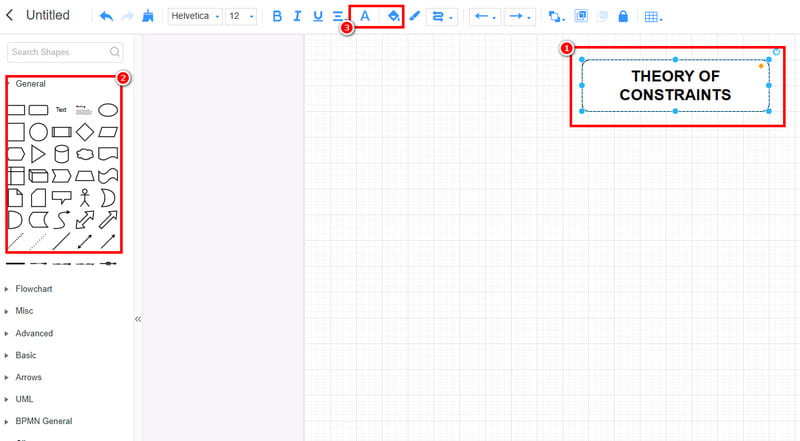
To add color to the shape and text, use the Fill and Font features above.
Lastly, click the Save function to keep your work on your account. You can also use the Export feature to save it on your device.
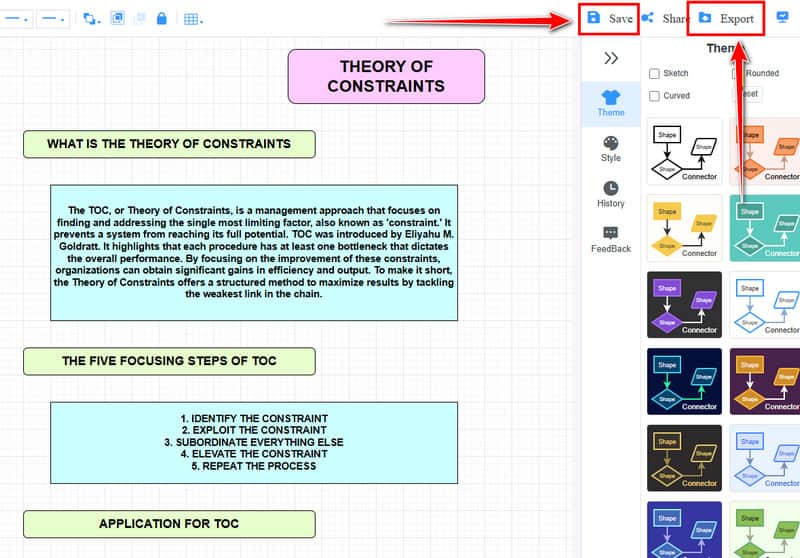
Click here to see the organized information of the TOC designed by MindOnMap.
With this method, you can effectively organize all the information about TOC. You can even use the tool easily, thanks to its simple layout. Thus, to transform your information into a well-structured output, always rely on MindOnMap. Besides that, MindOnMap can also help you make a family tree, giving you a clearer understanding of your family history.
Part 7. FAQs about the Theory of Constraints
Can constraints be eliminated permanently?
The answer is no. Once the constraint is elevated, another will appear. This is the reason why TOS is an ongoing improvement, not a one-time fix.
Is TOC only for manufacturing?
It is not limited to manufacturing. You can also apply TOC to healthcare, project management, sales, marketing, and other service industries.
What is throughput in TOC?
It is about the rate at which the system flows and generates money through sales. Throughput is a key measure in TOC, alongside operating expenses and inventory.
Conclusion
Now, you have learned everything about the Theory of Constraints, including its focusing steps, application, and misunderstandings. Plus, if you want to organize all the information about TOC and turn it into an appealing, well-structured output, you must use MindOnMap.The tool can offer all the best features you need to organize your data, making it more ideal and reliable for users.